
What Dances Are Done at Weddings? The Full Reception Order
- gregwilliams010
- 1 day ago
- 15 min read

The dances done at weddings typically follow a set order: first dance, father-daughter dance, mother-son dance, wedding party dance, and then open dancing for all guests. Many receptions also include a cultural dance, an anniversary dance, and a final last dance to close out the night.
Key Takeaways
The standard reception dance order runs first dance, parent dances, wedding party dance, then open dancing, with a last dance closing the evening.
Waltz, foxtrot, rumba, tango, and swing are the most common first dance styles, each pairing with a different tempo range (waltz sits around 84-96 BPM, foxtrot around 112-120 BPM).
Nightclub two-step and country two-step are the easiest beginner-friendly styles for couples with little dance experience.
Cultural dances like the Hora, Greek line dances, and the Polish money dance carry specific traditions and typically slot in right after the parent dances.
Dance professionals generally recommend 8-12 weeks of practice for a choreographed first dance, depending on complexity.
Houston's average wedding spend reaches $38,839, according to Houston First Travel & Tourism Data, and reception entertainment, including dance planning, is one of the areas couples invest in most.
If you're planning a wedding in Houston, Austin, Dallas, or San Antonio, you've probably already found a dozen conflicting lists of "essential" wedding dances online. Some skip cultural traditions entirely. Others treat the father-daughter dance and mother-son dance as optional add-ons rather than core moments most families expect.
At Uptown Drive, we've performed the soundtrack behind hundreds of these moments across Texas, and the pattern is consistent: couples who plan the dance order early have calmer receptions and fuller dance floors. This guide walks through every dance done at a modern wedding reception, in the order it typically happens, plus the cultural traditions, beginner-friendly options, and logistics that most planning articles gloss over.
As of 2026, Houston ranks 7th nationally among U.S. cities for best places to get married, according to a study cited by CultureMap Houston, and premium-tier weddings now account for 18% of the market's 40,072 annual bookings. More couples means more receptions, and more receptions means more decisions about exactly which dances make the cut.
What Are the Popular Dances at Weddings?
The popular dances at a wedding reception are the first dance, father-daughter dance, mother-son dance, wedding party dance, cultural or cake-cutting dances, and open dancing for all guests. Each one serves a different purpose: some are ceremonial, some are participatory, and some exist purely to get the whole room moving.
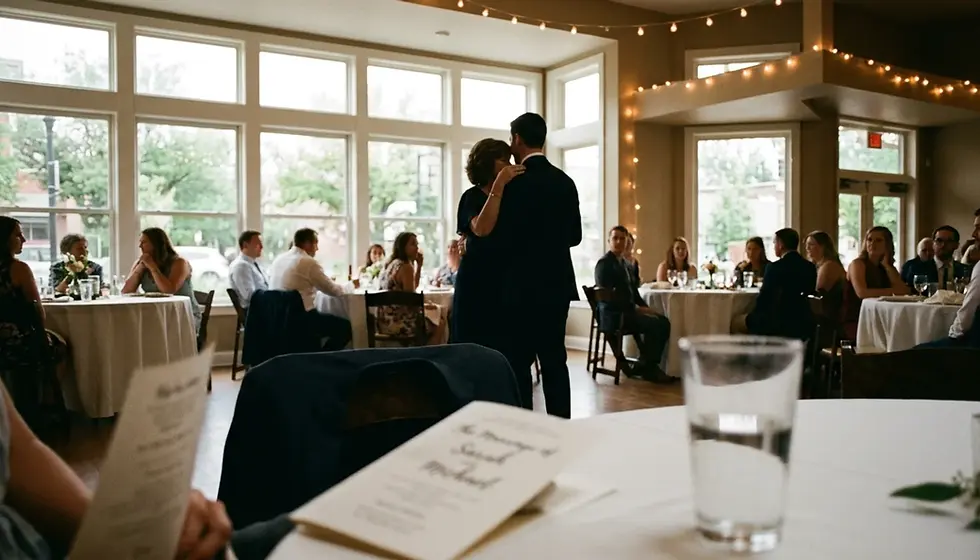
First, the first dance belongs exclusively to the couple and typically opens the reception's dance portion. Specifically, it's the moment guests expect to be quiet and watch, which is why many couples choose a slower, more emotional song for it.
Additionally, parent dances (father-daughter and mother-son) follow shortly after, often within the same 15-20 minute window. As a result, DJs and bands frequently group all three dances together at the start of the reception before opening the floor to everyone else.
The wedding party dance, where bridesmaids and groomsmen join in, has become increasingly common since the mid-2010s. It's a lighter, often choreographed moment that bridges the formal dances and general open dancing. Some Houston couples we've worked with skip this dance entirely in favor of moving straight to open dancing, which is a completely reasonable choice if the timeline is tight.
In What Order Are Wedding Dances Supposed to Happen?
The typical order of wedding reception dances runs: first dance, father-daughter dance, mother-son dance, wedding party dance, then open dancing for all guests, with a last dance to close the night. This sequence has become the default structure at most American receptions, though couples regularly adjust it.
Notably, some receptions swap the father-daughter and mother-son dances or combine them into a single "parent dance" set to save time. In contrast, other couples separate them by 20-30 minutes, placing one right after dinner and the other after toasts.
For example, a common Houston reception timeline looks like this: cocktail hour, dinner, welcome toast, first dance, parent dances, wedding party introduction and dance, open dancing, cake cutting (sometimes with its own short dance moment), and a final last dance before the couple exits.
A live band changes this order slightly compared to a DJ, because a band needs a few minutes between sets to reset instrumentation or switch singers. At Uptown Drive, we build these transitions into the set list ahead of time so there's no dead air between the parent dances and the moment the floor opens up.
Dance | Typical Timing | Who Participates | Common Length |
First Dance | Right after entrance or right after dinner | Couple only | 2-3 minutes |
Father-Daughter Dance | Immediately after first dance | Bride and father (or chosen parent figure) | 1-2 minutes |
Mother-Son Dance | Immediately after father-daughter dance | Groom and mother (or chosen parent figure) | 1-2 minutes |
Wedding Party Dance | After parent dances, before open floor | Bridesmaids and groomsmen | 1-3 minutes |
Open Dancing | Remainder of reception | All guests | 2-3 hours |
Cultural Dance (if included) | Early in open dancing | Guests, often led by family | 5-10 minutes |
Last Dance | Final song of the night | Couple and remaining guests | 3-4 minutes |

Who Goes First, Mother-Son or Father-Daughter?
Most receptions run the father-daughter dance before the mother-son dance, but there's no fixed rule requiring this order. The sequence is a tradition, not a requirement, and plenty of couples reverse it or run both dances simultaneously on the floor.
Traditionally, the bride's father-daughter dance follows directly after the couple's first dance, since it maintains the emotional momentum of the opening moment. The groom's mother-son dance then follows, often to a different tempo or genre to signal a shift in mood.
For blended families or couples without a clear "mother" and "father" figure available, this structure adapts easily. Some couples dance with a stepparent, an aunt, uncle, or grandparent instead. Others combine both parent dances into a single song where all four (or more) family members dance together on the floor at once, which works particularly well for shorter reception timelines. At Uptown Drive, we regularly help couples work through these decisions when they request a quote, since our band's multi-genre range means we can shift smoothly from a slow ballad for a father-daughter dance into something more upbeat for the mother-son moment, without needing a DJ's playlist crossfade.
What Are the Most Common Line Dances at Weddings?
Line dances are group dances performed in rows without partners, and they're a staple of open dancing at weddings because they require no dance experience and get large groups moving at once. The most recognizable examples include the electric slide, cha-cha slide, and various country line dance routines.
Specifically, line dances work well at Texas weddings because they bridge generational gaps. Grandparents, teenagers, and everyone in between can join a line dance with minimal instruction, unlike partner dances that require some coordination between two people. As a result, bands and DJs often schedule a line dance 45-60 minutes into open dancing, once the floor has warmed up but before energy starts to dip. This is also a natural moment for a live band to hand the mic to guests for a quick line dance callout, something a recorded playlist can't replicate.
In Houston specifically, country-influenced line dances remain popular at both rustic-venue weddings and downtown ballroom receptions, reflecting the broader Texas wedding culture where two-step and country dance experience runs deep, even among younger guests who grew up two-stepping at family events.
What Are the Best First Dance Styles for Beginners?
The easiest first dance styles for beginners are nightclub two-step and country two-step, both of which use simple, repeatable steps that look choreographed with minimal practice. Couples with zero formal dance background typically start with one of these two options before considering anything more technical.
Nightclub two-step works well because it's a slow, swaying pattern set to a moderate tempo, meaning it forgives small timing mistakes. Country two-step, by contrast, involves more forward movement across the floor, which suits couples who want visible motion without complex footwork.
For couples ready for something with more visual impact, the following styles appear consistently in wedding dance planning guides:
Waltz: the most traditional and widely chosen first dance style, danced in 3/4 time around 84-96 BPM. A Viennese waltz variant moves faster and feels more playful.
Foxtrot: a smooth, elegant style that works in both classic standards and modern pop songs, typically danced around 112-120 BPM in 4/4 time.
Rumba: a romantic, sensual Latin style for couples wanting more passion in their movement without the speed of salsa.
Tango: a dramatic, bold choice for couples comfortable commanding the room's attention.
Swing: covers several sub-styles including jitterbug, jive, boogie woogie, Lindy hop, and East and West Coast swing, all higher-energy and best suited to upbeat songs.
Dance professionals generally recommend 8-12 weeks of lessons before a wedding, depending on how choreographed the routine gets. Simpler styles like nightclub two-step can be learned in a few sessions; a full choreographed swing or tango routine takes longer.
What Are the 7 Most Popular Types of Dance for a First Dance?
The seven most common wedding first dance styles are waltz, foxtrot, rumba, tango, swing, salsa, and nightclub two-step. Each style suits a different song tempo, energy level, and skill requirement, which is why couples typically choose based on their comfort level and the mood they want to set.
Waltz: Classic, timeless, danced to slower ballads in 3/4 time. Works for nearly any traditional love song.
Foxtrot: Smooth and versatile, adapts to both vintage standards and current pop ballads without feeling dated.
Rumba: Romantic Latin style, slower tempo, ideal for couples wanting intimacy without high energy.
Tango: Dramatic and passionate, a strong choice for couples wanting a bold, memorable statement dance.
Swing: High-energy, includes jitterbug and Lindy hop variations, best for upbeat songs and couples who enjoy performing.
Salsa: Fast-paced Latin style, popular with couples who have some dance training and want a showstopping moment.
Nightclub Two-Step: The most beginner-friendly option, a simple swaying pattern that suits nearly any slow to mid-tempo song.
Additional styles that show up less frequently but still appear in wedding planning include mambo, cha-cha, samba, merengue, bachata, hustle, and bolero. Most couples we work with at Uptown Drive gravitate toward waltz, foxtrot, or nightclub two-step simply because those styles pair with the widest range of song choices, including custom requests our band incorporates into a live set.

What Cultural Dances Are Common at Weddings?
Cultural wedding dances are traditional group or partner dances tied to a couple's heritage, and they typically appear during open dancing rather than as part of the formal dance order. The most recognized examples include the Hora, Greek line dances, and the Polish money or apron dance.
The Hora is a Jewish circle dance typically performed to "Hava Nagila" or similarly energetic traditional music. It often kicks off the open dancing portion right after the parent dances, and it's common for the couple to be lifted on chairs during the dance. Guests join by linking arms and moving in a circle, so no prior dance experience is required, just a willingness to jump in.
Greek receptions frequently feature the Kalamatiano, Tsamiko, and Tsifteteli, each a distinct line or circle dance with its own step pattern and music style. These dances usually involve a lead dancer at the front of the line who guides pacing, so new participants can follow along by watching the person ahead of them.
The Polish money dance, also called the apron dance or Pani Mloda, invites guests to pay a small amount to dance briefly with the bride, with proceeds sometimes going toward the honeymoon. This tradition, along with similar money dances in other cultures, typically happens later in the reception, once the crowd has loosened up.
If you're planning to include a cultural dance, tell your band or DJ the specific song and approximate timing during your planning calls, not the week of the wedding. At Uptown Drive, we ask about cultural traditions directly during the booking process because these moments often require a specific song, not a generic substitute, and getting it right matters more to families than almost any other part of the set.
How Do Guests Participate in Circle and Line Dances They Don't Know?
Most cultural circle and line dances use a simple repeating step pattern that new participants can pick up within the first 30 seconds by watching the people around them. The Hora, for example, involves linking arms and stepping in a circle, a movement most guests can follow immediately without instruction.
For more structured dances like the Kalamatiano, watching the lead dancer at the front of the line is the fastest way to learn the pattern mid-dance. A brief verbal cue from the emcee or bandleader, something as simple as "step, step, kick," helps guests unfamiliar with the tradition feel comfortable joining rather than standing on the sidelines.
How Do Blended Families and Non-Traditional Couples Handle Parent Dances?
Blended families and couples without a traditional mother-father structure typically adapt parent dances by substituting whoever raised them, combining dances into one song, or skipping the formal parent dance altogether in favor of a group family dance. There's no requirement to follow the traditional father-daughter and mother-son format exactly.
For example, some couples split one dance between two parent figures, dancing half the song with one and half with another. Others invite both parents onto the floor simultaneously for a single shared dance, which shortens the reception timeline while still honoring both relationships.
Additionally, some couples opt for a "family dance" instead of individual parent dances, where everyone who helped raise them, stepparents, grandparents, or guardians, joins the floor together for one song. This works particularly well for larger blended families where individual dances for every parent figure would take up too much reception time.
None of these adaptations require special coordination beyond telling your band or DJ who's dancing and in what order. A band with a flexible, multi-genre set, like the format Uptown Drive builds for every wedding, can shift smoothly between two different songs for two different parent dances without an awkward pause in between.
What Happens After Open Dancing? The Anniversary and Money Dances
The anniversary dance, sometimes called the bouquet dance, invites every married couple in attendance onto the dance floor for a slow song, with couples leaving the floor in stages based on how many years they've been married until only the newlyweds remain. It's typically placed an hour or so into open dancing, once the crowd has settled in.
This dance works as a sentimental pause in an otherwise high-energy reception. It also doubles as a subtle way to honor long-married guests, grandparents especially, who might not join the more athletic line dances or swing numbers later in the night.
The money dance, mentioned earlier in the context of Polish weddings, appears across several cultural traditions under different names, sometimes as an apron dance, sometimes as a dollar dance. If you'd rather not include it, that's a completely valid choice, and it's worth telling your coordinator early so it doesn't get added to the timeline by default. Couples who want clear boundaries around this tradition should specify a cutoff time or a designated song length so the moment doesn't run long and eat into the rest of the open dancing set.
What Should You Know About Choreographed Wedding Party Performances?
A choreographed wedding party performance is a planned dance routine, usually performed by bridesmaids and groomsmen, timed to happen while guests are seated so everyone has a clear view. These performances typically happen between dinner courses or right after toasts, rather than competing with open dancing for attention.
Specifically, scheduling the performance while guests are still at their tables solves the biggest logistical problem with choreographed routines: visibility. A wedding party dance performed during open dancing often gets lost in the crowd, while the same routine performed during a seated moment becomes the centerpiece of the room.
For live band receptions, this timing also works better musically. A live band, like Uptown Drive's live wedding bands setup, can perform the choreography's music with full instrumentation rather than a backing track, which adds noticeably more energy to a rehearsed routine than a recorded track played through a DJ system.
What Does It Cost to Plan Reception Entertainment and Dancing in Houston?
Reception entertainment costs in Houston vary significantly based on format, guest count, and whether you book a DJ or a live band. According to Houston First Travel & Tourism Data, Houston's average wedding spend reaches $38,839, roughly twice the market's median of $19,041, with entertainment representing one of the largest line items after venue and catering.
As of 2026, Houston's wedding market processes an estimated 40,072 annual bookings, and October alone accounts for about 13% of that volume, roughly 5,200 weddings. That concentration means popular bands and venues book up months in advance for fall dates specifically.
For couples weighing a live band against a DJ for their dance-focused reception, the honest answer is that a live band changes the emotional register of every dance on this list, but it's a larger investment than a DJ setup. If you want the first dance, parent dances, and open dancing all performed with real instrumentation and singers who can take last-minute requests, that's the value a band adds that a laptop and speaker system can't replicate. If your priority is stretching every reception dollar toward other line items, a DJ remains a reasonable choice.
Couples researching venues before booking entertainment can also check our wedding musicians in Austin resource for Hill Country-specific planning notes, or read our guide to the best songs played at weddings in Texas for song selection ideas across every dance in this reception order.

Practical Guidance: How to Plan Your Reception Dance Order Without Overcomplicating It
Planning your dance order well means making a few decisions early and communicating them clearly to your band or DJ, not building an exhaustive script for every song. Most reception timeline problems come from vague instructions, not from the dances themselves.
Decide your must-haves first. Choose which dances matter to your family: first dance, parent dances, and any cultural tradition. Everything else is negotiable.
Cut what doesn't fit your timeline. If your reception runs four hours, you likely don't have room for a wedding party dance, an anniversary dance, and a money dance. Pick two, not all three.
Tell your entertainment about cultural dances early. Specific songs and timing need to be confirmed weeks ahead, not the day of the wedding.
Give your band or DJ a name pronunciation guide. Parent names, especially for cultural dance announcements, get mispronounced more often than any other reception detail.
Set a boundary for money dances if you're including one. A soft cutoff, either by song length or by time, keeps the tradition from running long.
Practice your first dance for at least a few weeks. Even a simple nightclub two-step benefits from four to six practice sessions before the wedding.
Confirm your last song choice with your band. Whether you want an emotional ballad or a high-energy closer changes how the whole night winds down.
Common mistakes we see across hundreds of Texas receptions include: scheduling too many formal dances back to back without a break for regular dancing, forgetting to tell the band about a cultural dance until the reception has already started, and assuming a wedding party dance will look good on an open dance floor when it's designed for a seated audience. Each of these is avoidable with a single planning conversation weeks before the wedding.
Frequently Asked Questions
What are popular dances at weddings?
The most popular wedding dances are the first dance, father-daughter dance, mother-son dance, wedding party dance, and open dancing for all guests. Many receptions also include a cultural dance, such as the Hora or a Greek line dance, plus a last dance to close the night.
What is the most popular mother-son wedding dance song?
There's no single universally "most popular" mother-son song, since musical taste varies widely by family and generation, but the category tends toward sentimental ballads about growing up or gratitude. Couples working with a live band, like Uptown Drive, can request nearly any song in this category rather than choosing from a fixed list, since the band learns the arrangement specifically for the couple's set.
What do wedding bands cost?
Wedding band pricing varies based on band size, set length, travel distance, and whether the performance includes extras like live band karaoke or a choreographed set. Rather than publishing a fixed number that doesn't reflect your specific event, Uptown Drive provides a custom quote based on guest count, venue, and requested song list; you can request one directly at uptowndrive.com.
What is live band karaoke?
Live band karaoke is an interactive entertainment format where guests sing on stage backed by a full live band instead of a pre-recorded karaoke track. It typically happens later in a reception or corporate event, once the crowd is warmed up, and it turns guests into performers rather than spectators. Uptown Drive offers this as an optional add-on for weddings and corporate events across Texas.
Who goes first, mother-son or father-daughter dance?
Most receptions run the father-daughter dance first, immediately following the couple's first dance, then the mother-son dance right after. This order is a common tradition rather than a fixed rule, and couples frequently reverse it, combine both dances into one song, or adapt the format entirely for blended families.
What are the 7 most popular types of dance for a first dance?
The seven most common first dance styles are waltz, foxtrot, rumba, tango, swing, salsa, and nightclub two-step. Waltz and foxtrot remain the most frequently chosen because they pair well with a wide range of song tempos, while nightclub two-step is the easiest for beginners.
How far in advance should you book a wedding band for dance-focused entertainment in Texas?
Most couples in competitive markets like Austin and Houston book their wedding band 9 to 18 months in advance, particularly for peak season dates between spring and fall. October alone accounts for roughly 13% of Houston's annual weddings, so fall dates in particular fill up faster than off-peak months.
Can a live band take custom song requests for specific dances like the first dance or a cultural dance?
Yes, most professional live wedding bands, including Uptown Drive, build custom song requests directly into the performance rather than relying on a fixed set list. This matters most for parent dances and cultural traditions, where a specific song often carries personal or cultural significance that a generic playlist can't replace.
Final Thoughts on Planning Your Wedding Dance Order
The dances done at weddings follow a familiar backbone, first dance, parent dances, wedding party dance, and open dancing, but the specifics are yours to shape. Cultural traditions, blended family adaptations, and song choices for every category on this list are decisions worth making early rather than leaving to the week of the wedding.
As Houston's wedding market continues to grow in 2026, with premium-tier weddings now representing a larger share of the market's $1.56 billion in annual spending, couples are investing more thought into how their reception actually feels on the dance floor, not just how it looks in photos. The music behind each dance matters as much as the choreography.
Choosing the right entertainment for your wedding dance order is one of those decisions that shapes how the whole evening feels in memory. The food gets forgotten. The flowers fade. But the music, and the moment the whole room finally gets up to dance, stays with people. Uptown Drive has built its reputation across Austin, Houston, Dallas, and San Antonio on treating every one of these dances, from the first dance to the last song of the night, as a moment worth getting right.

If you're mapping out your own reception dance order and want a band that can move seamlessly from a waltz-tempo first dance to a full-energy open dancing set, get started with Uptown Drive and request a quote for your wedding date.
Written by Greg Williams, Owner & Band Leader at Uptown Drive
Content powered by inkSTR.co


Comments