
Live vs. Recorded Wedding Instrumental Music: Why Live Wins Every Time
- gregwilliams010
- May 2
- 14 min read

Wedding instrumental music refers to any non-vocal musical performance used during wedding ceremonies, typically covering the processional, interlude, and recessional moments that shape a couple's most photographed memories. You have two fundamentally different options: a live musician or ensemble performing in real time, or a pre-recorded playlist streamed through a speaker. Both can deliver the right notes. Only one can read the room.
Live musicians adapt in real time: A professional musician can pause, slow down, or extend a piece mid-performance when a guest arrives late or a processional runs long. A Spotify playlist cannot.
Recorded playlists dominate online search: Brooklyn Duo's Brooklyn Duo Wedding Instrumental Music Playlist on Spotify has accumulated 17,800 saves, making it the top-ranking resource for couples searching for ceremony music. It's a beautiful resource. It is not a substitute for presence.
The live music market is growing fast: According to Cognitive Market Research, the global live music market reached approximately $35.5 billion in 2026 and is projected to nearly double to $69.3 billion by 2033, growing at a CAGR of 8.74%. Weddings are a named application segment in that market.
Cost is the primary hesitation: Neither the top-ranking Spotify playlist nor the leading YouTube guitar playlist includes any pricing information, leaving couples without a framework for the live vs. recorded cost decision.
Acoustic performance fills a room differently: Live instruments interact with the physical space, creating natural reverb and warmth that speakers reproducing a recorded track cannot replicate.
This article addresses every gap competitors ignore: logistics, pricing context, acoustic physics, emotional psychology, and a direct song-by-song framework for ceremony planning.

What Makes Wedding Ceremony Music Different from Reception Entertainment?
Wedding ceremony music is the structured, moment-specific soundtrack played during the formal ritual sequence of a wedding, covering the guest seating period, the processional entrance of the wedding party, the couple's entrance, any interlude music during the ceremony itself, and the recessional. Unlike reception entertainment, ceremony music serves a functional, emotionally charged role where timing is everything and the margin for error is zero.
The ceremony is the only part of a wedding where every single guest is seated, silent, and focused on one thing. That concentrated attention makes the musical choice more consequential here than anywhere else in the day. According to Grand View Research, the U.S. wedding services market was valued at $64.93 billion in 2026. Entertainment and music sits alongside catering as one of the established service categories driving that number.
Couples planning music holistically across the full wedding day arc, from arrival through ceremony, cocktail hour, dinner, and dancefloor, represent one of the strongest planning trends identified for 2026 weddings. Ceremony music is the opening statement of that arc. Get it right, and you set the emotional tone for everything that follows. Our team at Uptown Drive consistently sees that couples who invest in the ceremony soundtrack create the moments their guests still talk about years later.
If you want a broader look at how venues shape ceremony music choices, the guide to Austin's hidden live music venues for wedding receptions covers how room acoustics and spatial design affect every entertainment decision you make.

What Is the Best Instrumental Wedding Song?
The best instrumental wedding song depends on the emotional moment it accompanies and the musical format delivering it. For processionals, Canon in D by Johann Pachelbel remains the most performed ceremony instrumental worldwide, combining harmonic predictability with genuine emotional weight. For couple entrances, contemporary covers of songs like "Perfect" by Ed Sheeran, "All of Me" by John Legend, and "Golden" by Harry Styles have become the dominant requests in 2026 wedding planning.
Brooklyn Duo's top-ranking Spotify playlist, with 17,800 saves, offers a useful window into what couples actually request. The playlist includes Canon in D and Ave Maria representing classical tradition, then pivots to pop covers including "Shallow" from A Star Is Born, "Easy On Me" by Adele, and "golden hour" by JVKE. The jazz standard "La Vie en Rose" and Tracy Chapman's "Fast Car" also appear, confirming that the contemporary wedding instrumental repertoire blends three centuries of music without apology.
Here is the practical framework: classical pieces like Canon in D and "Après un rêve" by Fauré work best for solemn, traditional processionals. Contemporary pop covers like "Thinking Out Loud" and "You Are the Reason" suit modern couples who want recognizable emotion without lyrics during the walk down the aisle. Jazz standards like "What a Wonderful World" work beautifully for recessionals, where a lighter mood is appropriate.
For a deeper dive into song selection, the ultimate guide to the best songs played at weddings in Texas for 2026 covers repertoire across every moment of the day. And if you're specifically planning the walk-in, the guide to wedding walk-in music is worth your time before you finalize anything.
Classical Versus Contemporary: Which Direction Should You Go?
Neither direction is wrong. The real question is whether your ceremony has a single emotional register or a layered one. A full classical program, think Canon in D for the processional, Ave Maria during the ring exchange, and a Pachelbel or Bach piece for seating, creates a unified, formal atmosphere. A mixed program using classical for the seating music and a pop cover like "Can't Help Falling in Love" for the bride's entrance signals that this couple honors tradition but brings their own personality to it. That second approach is the more popular choice in 2026 wedding planning, particularly across Austin, Dallas, and Houston markets.
Why Do Live Musicians Outperform a Recorded Playlist for Ceremonies?
Live musicians outperform recorded playlists for wedding ceremonies because live performance is inherently adaptive, physically immersive, and psychologically significant in ways that a speaker system playing a pre-recorded track cannot replicate. The difference is not a matter of audio quality. It is a matter of what music does to a room when a human being is creating it in real time.
Consider the logistics first. A processional for a wedding party of eight people takes longer than the same processional for two people. If the bride pauses at the doorway, if a flower girl decides to sit down mid-aisle, if a photographer needs one more moment before signaling the entrance: a live musician reads those cues and extends the musical phrase naturally. A Spotify playlist does not pause. It plays to its own clock, leaving the processional either rushed or awkwardly silent while someone fumbles with a phone to restart the track.
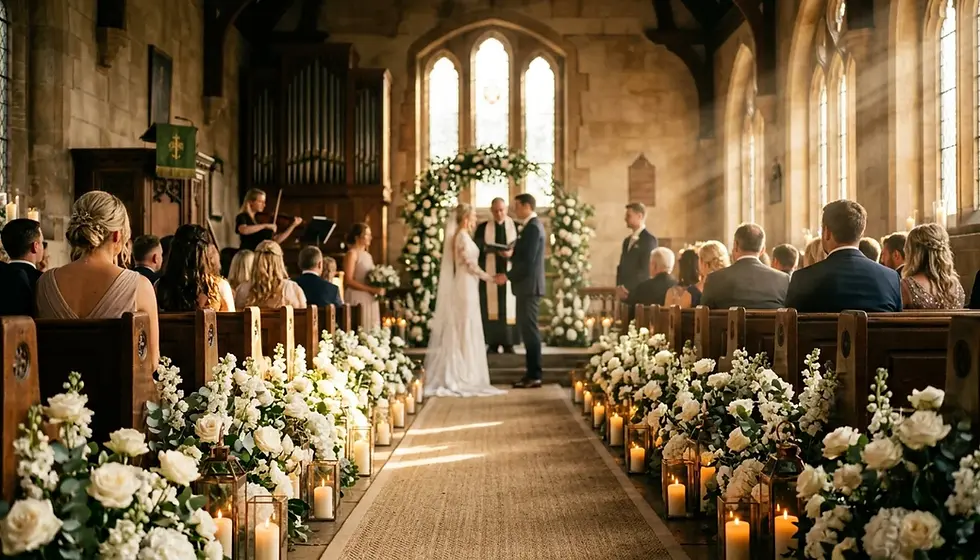
The acoustic difference is also real. Live instruments, specifically piano, cello, violin, and acoustic guitar, interact with the room's physical properties. In a stone church, the natural reverb of a cello creates warmth that a speaker cannot. In an outdoor Hill Country venue, live sound travels differently than amplified recorded audio, filling the space organically rather than projecting from a single point source. At Uptown Drive, we bring weather-resistant equipment and sound engineering expertise specifically for Texas outdoor venues, because the acoustic environment changes everything about how music lands.
The psychological dimension is equally significant. Multiple studies on live performance versus recorded music have found that audiences perceive live music as more emotionally resonant and rate the overall event experience higher when live musicians are present. This is not nostalgia. It is the human response to watching another person create something in front of you. Ceremony guests who witness a cellist lean into a phrase during the bride's entrance experience something fundamentally different from guests who hear the same notes from a Bluetooth speaker.
What Are the Top 5 Wedding Songs for Ceremonies in 2026?
The top wedding songs for ceremonies in 2026 reflect the genre-fluid, emotionally direct approach that defines contemporary wedding music planning. Rather than ranking by chart position, these selections are ranked by ceremony moment and frequency of request across professional musicians working the Texas and Colorado markets.
Song | Artist / Origin | Best Ceremony Moment | Instrumental Format |
Can't Help Falling in Love | Elvis Presley | Bride's processional | Piano, cello, or guitar |
Perfect | Ed Sheeran | Couple's entrance or interlude | Acoustic guitar or piano |
Canon in D | Johann Pachelbel | Wedding party processional | String quartet or piano |
All of Me | John Legend | Bride's processional or first look | Piano |
golden hour | JVKE | Contemporary processional or seating | Piano or acoustic guitar |
The inclusion of "golden hour" by JVKE alongside Canon in D in the same ceremony plan is increasingly common for couples under 35, and it works because both pieces share a cyclical, hypnotic harmonic structure. A skilled musician transitions between them fluidly. A playlist creates a jarring genre shift if the timing is off.
For bride entrance planning specifically, the 10 unforgettable bride entrance wedding songs resource covers vocal options alongside instrumental choices if you're on the fence about which direction to take.
Who Walks Down the Aisle First, and How Does Music Timing Work?
The traditional wedding processional order begins with grandparents, followed by parents of the groom and parents of the bride, then the wedding party (groomsmen and bridesmaids, typically paired), followed by the ring bearer and flower girl, and finally the bride with her escort. Each group requires its own musical timing cue, and the total processional can span anywhere from four to twelve minutes depending on the wedding party size and aisle length.
This is where the gap between live musicians and recorded playlists becomes undeniable. A single Spotify track runs a fixed length. If the wedding party processional runs longer than the chosen song, the track either ends in silence or loops awkwardly. A live musician, by contrast, can repeat a phrase, modulate to a related key for textural variety, or seamlessly transition into a second piece when given a visual cue from the officiant or wedding coordinator.
Professional ceremony musicians develop specific cuing protocols with wedding planners. The standard approach uses three distinct musical signals: a shift in dynamics or tempo for the wedding party entrance, a distinct melodic theme change for the flower girl and ring bearer, and a third, often more emotionally elevated, piece for the bride's entrance. Pre-recorded playlists require a dedicated operator managing a playlist queue in real time, which typically means a phone or laptop sitting visibly on a folding table near the altar. Live musicians make the production invisible.
For couples working with venue coordinators in Austin, Dallas, San Antonio, or Houston, the wedding musicians in Austin page covers how professional ceremony musicians coordinate with venue timelines and officiants to keep every entrance on cue.

Live Musicians vs. Recorded Playlists: A Direct Comparison
Live wedding instrumental music and pre-recorded playlist streaming are two structurally different approaches to ceremony entertainment, and the right choice depends on your venue type, budget range, and how much the ceremony moment matters to you relative to reception entertainment spending. Here is an honest side-by-side comparison covering every dimension couples typically ask about.
Factor | Live Musicians | Recorded Playlist |
Timing adaptability | Fully adaptive: can pause, extend, or transition on cue | Fixed: plays to its own clock regardless of ceremony flow |
Acoustic quality | Natural room interaction, organic warmth, no speaker artifacts | Dependent on speaker quality and placement; can sound thin outdoors |
Emotional impact | High: live performance triggers stronger audience emotional response | Moderate: music is familiar but lacks performative presence |
Typical cost range | $500 to $2,500+ depending on ensemble size and market | Free to low cost via Spotify, YouTube, or purchased track licenses |
Song customization | High: professionals learn specific arrangements on request | Limited to what exists in recorded form |
Logistical complexity | Requires booking, sound check, and coordination with venue | Requires PA system, playlist operator, and backup device |
Backup contingency | Professional musicians carry instrument redundancy and have backup plans | Vulnerable to technology failure, Bluetooth dropout, or device issues |
Visual ceremony presence | Adds elegant visual element to ceremony setup | Speaker system visible or hidden; no visual contribution |
Best suited for | All venue types, especially churches, estates, outdoor Hill Country venues | Very small intimate ceremonies or strict budget constraints |
The cost range for live musicians is the figure competitors never publish. A solo acoustic guitarist for a 30-minute ceremony typically runs $400 to $700 in most Texas markets. A professional piano-and-cello duo runs $900 to $1,800. A full string quartet for a formal church ceremony can reach $2,500 or more. Compared to a full reception band budget of $5,000 to $15,000, ceremony musician cost is often the most undervalued line item in the wedding entertainment budget.
Skip the Bluetooth speaker approach for outdoor venues in particular. Wind, crowd ambient noise, and speaker placement limitations routinely cause recorded music to sound distant or uneven in outdoor settings. Live acoustic instruments project naturally in those environments in ways that speaker technology simply cannot match.
What Is the Number One Song Played at Weddings?
"Can't Help Falling in Love" by Elvis Presley consistently ranks as the most frequently played wedding song across ceremony and reception contexts in the United States, a position it has held for decades and reinforced through recent cover versions by artists including Haley Reinhart, whose acoustic version became a viral moment in its own right. In instrumental format, the song translates beautifully to piano, cello, or acoustic guitar because its simple waltz-time melody carries emotional weight without relying on lyrics.
According to wedding music trend reporting from brendanmccahey.com, ceremony and cocktail hour music in 2026 is shifting noticeably toward contemporary love songs, acoustic covers, and stripped-back instrumental arrangements featuring piano or acoustic guitar. "Can't Help Falling in Love" sits at the intersection of all three categories, which explains its enduring dominance.
For couples who want something less expected, "Golden" by Harry Styles, "Free" by Zac Brown Band, and "Home" by Edward Sharpe and the Magnetic Zeros all appear in Brooklyn Duo's playlist and translate exceptionally well to live instrumental performance. A talented musician can bring the emotional architecture of those songs through melody alone, without a single lyric.
If you're building out the full reception song list alongside your ceremony selections, the wedding music alternatives guide covers creative approaches beyond the standard playlist that can make the entire day feel cohesive.
How Should You Choose Between a Live Musician and a Recorded Playlist?
Choosing between live wedding instrumental music and a recorded playlist comes down to three honest questions: How much does the ceremony moment matter to you versus the reception? What is your venue's acoustic environment? And what is your realistic entertainment budget across the full day?
If your ceremony is in a reverberant space, a stone church, a vaulted barn, or an outdoor estate, live acoustic instruments will sound extraordinary with zero amplification equipment needed. The room does the work. A recorded track in those same spaces requires careful PA setup to avoid echo, muddiness, or hollow projection.
If your budget forces a choice between a live ceremony musician and a live reception band, the calculus is straightforward: your reception lasts three to five hours and is where guests spend the majority of their time. A professional live band like Uptown Drive's live wedding band service covers reception from cocktail hour through last dance. Use a recorded playlist for ceremony seating music, hire a live soloist or duo for the processional and recessional specifically, and bring in a full band for the reception. That hybrid approach delivers live music impact at the moments that matter most without overextending your budget.
Red Flags When Booking Live Ceremony Musicians
Not every musician who markets wedding services operates at the same professional standard. Before you sign any contract, ask four specific questions. First: will they attend a sound check at your venue before the ceremony? Any professional worth booking will say yes without hesitation. Second: what is their backup plan if a musician is ill or has an emergency? A solo musician with no backup plan is a liability. Third: do they carry their own sound equipment if amplification is needed? Fourth: how many weddings have they performed in the last 12 months, specifically ceremonies, not just receptions?
For couples in Texas markets, the Texas wedding bands resource is a useful starting point for finding professionally vetted musicians across Austin, Dallas, Houston, and San Antonio. You can also explore the Austin wedding bands category for locally-specific recommendations and reviews.
What to Request from Your Ceremony Musician
A written setlist with song titles and timing estimates for each processional segment
Confirmation of the cuing system they use with your wedding coordinator or officiant
A recorded sample or live demo of any custom song arrangement you are requesting
Specific confirmation of equipment needs (power access, setup space, chair requirements)
Their policy on overtime if the ceremony runs long
Every one of those items is standard for professional musicians. If a musician hesitates on any of them, that hesitation tells you something important.
Frequently Asked Questions About Wedding Instrumental Music
How much does a live musician cost for a wedding ceremony?
Live ceremony musician pricing typically ranges from $400 to $700 for a solo acoustic guitarist, $900 to $1,800 for a piano-and-cello duo, and $2,000 to $2,500 or more for a full string quartet, depending on the market and performance length. Texas markets including Austin, Dallas, and Houston fall within these ranges. Most professional ceremony musicians book for a minimum of 60 to 90 minutes to cover setup, performance, and teardown time.
Can a live musician perform both ceremony and cocktail hour music?
Yes, and many couples in 2026 are booking musicians for a combined ceremony-plus-cocktail-hour package, which typically adds 45 to 60 minutes of ambient background music during the cocktail reception following the ceremony. This approach is cost-efficient because the musician is already on-site and warmed up, and acoustic background music during cocktail hour creates a natural bridge between the ceremony's emotional intensity and the reception's energy. Ask your musician about package rates for combined bookings before accepting a ceremony-only quote.
What is the difference between a string quartet and a piano-cello duo for ceremonies?
A string quartet (two violins, viola, cello) produces a fuller, more orchestral sound best suited to large formal venues including churches, ballrooms, and estate ceremonies with 150 or more guests. A piano-cello duo produces a more intimate, warm sound that works beautifully in smaller spaces and outdoor settings. The duo format also offers more flexibility for contemporary pop covers because piano carries harmonic complexity that strings alone sometimes cannot. For venues under 150 guests, a duo or trio often sounds better than a quartet because the sound fills the space without overwhelming it.
Is Canon in D overused at weddings in 2026?
Canon in D remains the most widely recognized wedding processional piece, and its harmonic structure, built on a repeating bass line with ascending melodic variations, genuinely suits the processional's gradual emotional buildup. Whether it feels overused depends entirely on how it is performed. A solo guitarist playing a simple chord arrangement sounds generic. A cellist performing a rich, ornamented version of the same piece sounds timeless. The piece is not the problem; the arrangement and instrumentation make all the difference. If you want something less common, consider Fauré's "Après un rêve" or Debussy's "Clair de Lune" as ceremony processional alternatives.
Do I need a PA system if I hire a live ceremony musician?
It depends on your venue and guest count. For ceremonies under 80 guests in an enclosed space with good natural acoustics, a solo acoustic guitarist, pianist, or string duo typically requires no amplification at all. For outdoor ceremonies of any size, or indoor venues with high ceilings and poor reverb, light amplification through a compact PA system is advisable. Professional musicians working Texas outdoor venues know this and will typically arrive with compact battery-powered amplification as a precaution. Always ask your musician directly what they recommend for your specific venue layout.
What happens if a ceremony musician cancels on my wedding day?
Professional musicians operating as a registered business entity should carry cancellation insurance and maintain a network of substitute musicians for emergencies. Before booking, ask specifically about their cancellation policy and backup musician protocol. A reputable musician or music company will either provide a qualified substitute of equal professional caliber or offer a full refund plus reasonable compensation for the inconvenience. Never book a ceremony musician without a written contract that addresses cancellation, substitution, and refund terms explicitly.
How far in advance should I book live ceremony musicians for my Texas wedding?
For weddings in peak season, specifically April through June and September through November in Texas markets, booking your ceremony musician 9 to 12 months in advance is strongly advisable. The most sought-after professional musicians and ensembles in Austin, Dallas, Houston, and San Antonio fill their peak-season calendars quickly, often by the prior fall for the following spring season. For off-peak dates including winter weekday weddings or January through February, 4 to 6 months of lead time is typically sufficient, though earlier is always better for the arrangements you want.
Making the Right Choice for Your Ceremony Soundtrack
Wedding instrumental music, whether played by a live musician or streamed from a playlist, sets the emotional register for the most formal moment of your entire celebration. The comparison in this article makes the functional case for live performance clearly: adaptability, acoustic quality, emotional resonance, and ceremony logistics all favor a professional musician over a pre-recorded track. The cost difference is real, but it is smaller than most couples assume, particularly when weighed against what a live musician actually delivers at the one moment when every guest is watching and listening.
As of 2026, the trend toward holistic day-of music planning, covering ceremony, cocktail hour, dinner, and reception as a unified musical arc, means the ceremony musician and the reception band are increasingly chosen as a coordinated pair rather than separate line items. The genre-fluid, emotionally direct repertoire that defines today's wedding playlists, from Canon in D to "golden hour" to "La Vie en Rose," translates beautifully to live acoustic performance in ways that streaming never quite matches.
If you are planning a wedding in Austin, Dallas, San Antonio, Houston, or Denver and want to discuss how live ceremony and reception music work together, reach out to Uptown Drive for a personalized consultation. With over 250 five-star reviews and professional musicians with major stage and international touring experience, we can help you build a ceremony and reception music plan that feels cohesive from the first note of the processional to the last song of the night.

When your ceremony calls for music that moves with the moment, not against it, a live ensemble from Uptown Drive's live wedding bands brings the professional performance experience your ceremony deserves. Request a quote here and tell us about your venue, your must-play songs, and your timeline.


Comments