
Wedding Live Music Bands: Everything You Need to Know

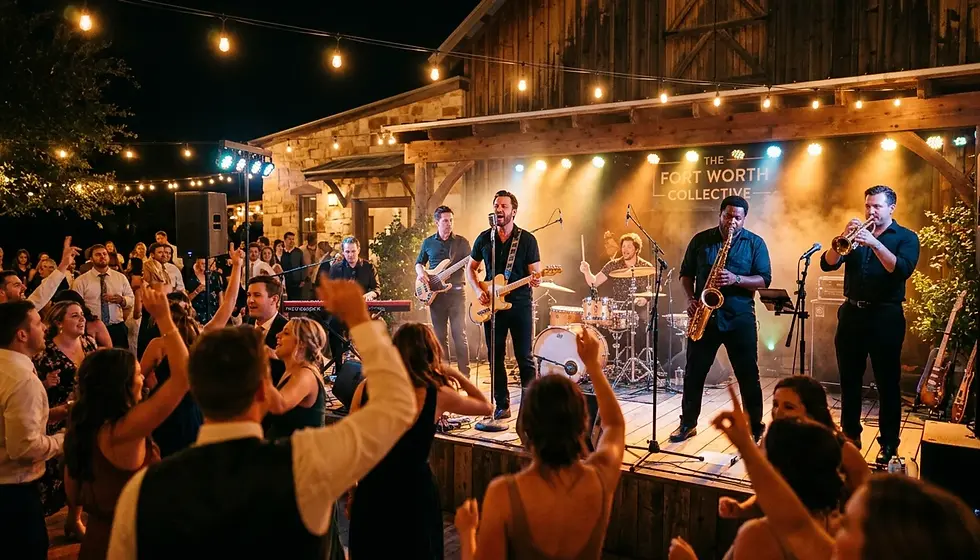
Wedding live music bands are professional musical ensembles hired to perform live at wedding ceremonies, cocktail hours, and receptions. Unlike a DJ who plays pre-recorded tracks, a live band creates an interactive, high-energy atmosphere with real instruments and vocals. In 2026, couples across Texas and beyond consistently rank live music as one of the highest-impact entertainment decisions they make.
Wedding live music bands typically cost between $3,000 and $15,000 in the U.S., depending on band size, hours performed, and geographic market.
Booking 12 to 18 months in advance is the industry standard to secure your preferred band at standard rates, especially for peak Saturday dates.
A 4 to 6-piece band covers ceremony, cocktail hour, and reception, with a typical setup requiring 90 minutes before the first performance.
The U.S. live music market is projected to reach USD 19.7 billion in 2026, with the South holding the largest regional share at 33.05% (Mordor Intelligence).
Hybrid models pairing a live musician with a DJ are a fast-growing option in 2026, offering full-night energy at a lower overall cost than a complete band.
Professional wedding bands should carry Public Liability Insurance and current equipment certifications as standard compliance requirements for most venues.
TL;DR
Wedding live music bands range from solo acoustic performers to 14-piece ensembles, each suited to different event sizes, budgets, and musical styles.
U.S. reception band pricing starts around $3,000 to $5,000 for a 4 to 6-piece group, scaling to $7,000 to $15,000 for larger ensembles in Texas markets.
The most important hiring steps are audition via demo video, verify insurance, review the contract for overtime clauses, and confirm your venue's sound restrictions.
Live bands outperform DJs on guest interaction and emotional energy; DJs offer broader song catalogs and lower costs. Neither is universally better.
Genre matching matters: choose Latin or salsa ensembles for multicultural receptions, jazz quartets for black-tie ceremonies, and high-energy cover bands for dance-focused receptions.
Planning wedding entertainment in 2026 means navigating more options than any previous generation of couples. Streaming culture has raised the bar for what guests expect from live performance. At the same time, the post-pandemic surge in live experiences has pushed demand for skilled wedding musicians to record levels, with the South accounting for nearly a third of all U.S. live music spending.
Whether you are planning an intimate Hill Country ceremony outside Austin, a Dallas ballroom gala, or a destination wedding in San Antonio, the decisions you make about live entertainment shape how your guests remember the entire day. This guide covers every dimension of choosing, hiring, and working with wedding live music bands, from the first Google search to the final song of the night.
At Uptown Drive, we have performed at weddings across Austin, Dallas, Houston, San Antonio, and Denver, and we have fielded nearly every question a couple can ask about live music. The answers below draw directly from that experience.

What Exactly Are Wedding Live Music Bands and What Do They Do?
Wedding live music bands are professional musical groups that perform original or cover songs at wedding events using live instruments and vocals. A typical engagement covers multiple event segments: a ceremony prelude beginning roughly 20 minutes before the processional, the ceremony itself (45 to 60 minutes of performance), a cocktail hour set, and a multi-hour reception performance with scheduled breaks. Each segment requires different repertoire, volume levels, and instrumentation choices.
Band configurations range widely. Solo acoustic singer-guitarists handle intimate ceremonies for under 50 guests. A 3-piece trio covers a cocktail hour without overpowering conversation. A 4 to 6-piece band is the most popular configuration for full receptions, handling rhythm, brass or keys, lead vocals, and backing harmonies simultaneously. For large galas and ballroom receptions with 200-plus guests, 10 to 14-piece ensembles deliver the kind of wall-of-sound energy that a smaller group physically cannot produce.
What separates a professional wedding band from a general cover band is preparation. Professional wedding musicians arrive with a pre-agreed setlist built around your specific song requests, rehearse transitions between event segments, coordinate directly with your venue and wedding planner, and carry backup equipment. At Uptown Drive, for example, every performance brief includes a detailed event timeline shared with the venue coordinator and catering team so that musical transitions align perfectly with toasts, dinner service, and the cake cutting.
For couples researching all of their entertainment options, the live wedding bands overview on the Uptown Drive site breaks down how professional ensembles structure their services from consultation through performance.
How Much Should a Live Band Cost for a Wedding?
Wedding live music band pricing in the U.S. depends on four primary variables: band size, hours of performance, geographic market, and the musicians' professional experience. In the Dallas and broader Texas market, solo ceremony musicians start as low as $230 to $400 for a single instrument, while full reception bands typically start around $3,000 to $5,000 for a 4 to 6-piece ensemble, scaling to $7,000 to $15,000 for 10 to 14-piece full bands. Elite multi-city ensembles like Sound Society Band, which performs across New York, Dallas, Houston, and Miami, start at $11,000.
Here is a practical pricing reference for U.S. wedding band configurations in 2026:
Band Configuration | Typical U.S. Price Range | Best For |
Solo acoustic musician | $230 to $650 | Ceremony or cocktail hour |
Acoustic duo | $600 to $1,200 | Small ceremonies, garden receptions |
3-piece band | $1,500 to $3,500 | Cocktail hours, micro weddings |
4 to 6-piece band | $3,000 to $7,000 | Full receptions, 75 to 175 guests |
7 to 9-piece band | $6,000 to $11,000 | Ballroom receptions, 150 to 300 guests |
10 to 14-piece full band | $7,000 to $15,000+ | Large galas, black-tie events |
Several factors push pricing toward the upper end of any range. Saturday bookings during peak wedding season (May through September) consistently carry the highest demand and rates. Winter weddings and weekday bookings offer meaningful cost savings, sometimes 15 to 20%, without sacrificing quality. Travel fees apply when the venue is more than 60 to 90 minutes from the band's base city. Early setup or late finish fees typically run $100 to $400 per additional hour, depending on band size.
One cost factor couples frequently overlook is the ceremony add-on. Many bands offer ceremony coverage as a separate package, with a solo acoustic guitar or piano typically adding $250 to $600 to the total booking. If you want continuous live music from the processional through the last dance, budget for this add-on explicitly when requesting quotes.
For couples planning a Texas wedding, the Austin wedding band page and the Dallas live wedding bands page offer market-specific guidance on what professional entertainment costs in each city.
Is a Live Band at a Wedding Worth It?
A live band at a wedding is worth the investment when guest interaction, visual energy, and emotional atmosphere are priorities for the couple. Live music creates a fundamentally different experience from recorded audio: musicians respond to crowd energy in real time, build momentum toward peak dance moments, and give the reception a theatrical quality that a DJ physically cannot replicate. The presence of real instruments and performers on stage signals to guests that this is a premium celebration.
The honest trade-off is cost and flexibility. A live band costs more than most DJ setups, and a six-piece ensemble cannot pivot instantly to a deep-cut request the way a DJ with a 50,000-song library can. But for most couples, the return on that investment appears in one clear metric: how packed the dance floor stays. At Uptown Drive, we consistently see that live band receptions produce longer, more sustained dancing periods than DJ-only events, particularly during the first 45 minutes after dinner when crowd energy is building.
Live bands also provide moments that become part of a wedding's story. A real wedding at Oheka Castle in Huntington, New York featured a 350-guest ceremony where an electric live band's performance of the horah became one of the most-cited memories in the couple's guest feedback. That kind of shared, spontaneous energy is impossible to manufacture from a playlist.
For couples weighing their options carefully, an honest look at wedding music alternatives can help clarify when a full band is the right call versus when a hybrid or acoustic setup serves better.
The short answer: if your budget allows a 4 to 6-piece professional ensemble and your venue has adequate space and acoustics, a live band is rarely the wrong choice. If budget is tight, a hybrid model pairing a live guitarist or vocalist with a DJ gives you live-music energy at a lower price point than a full ensemble.

What Is the Most Popular Wedding Band Type in 2026?
The most popular wedding band configuration in 2026 is the 4 to 6-piece cover band with a versatile setlist spanning pop, R&B, classic rock, and country-pop. This format dominates because it scales to most reception venues, covers multiple decades of recognizable music, and hits a price point that most mid-to-high budget couples can access. According to booking data from the UK market (a useful proxy for Western wedding trends), 4-piece bands are consistently the most-booked configuration, with pricing that reflects their broad applicability.
Genre preferences have shifted significantly by 2026. Couples increasingly request genre-blending setlists that mix pop hits with R&B, country-pop crossovers, and global rhythms to serve multicultural guest lists. A Texas wedding today might request Beyonce alongside George Strait, Bad Bunny, and a Motown medley. This demand is driving growth for versatile bands over genre specialists.
That said, specific event contexts still call for specific genre expertise. Black-tie galas and upscale cocktail hours pair best with jazz quartets or swing ensembles. Multicultural receptions with Latin family traditions are best served by bilingual salsa or cumbia ensembles. Country-focused Texas weddings often hire groups like the Mark Odom Band, a San Antonio country and variety group that has performed over 100 Texas weddings.
Hybrid models are the fastest-growing format in 2026. A live singer or guitarist performs during cocktail hour and key reception moments, while a DJ fills the gaps and handles late-night energy. This approach delivers live-music prestige without the full-band price tag. For couples on a mid-range budget, it is worth asking your preferred band whether they offer a hybrid package before ruling out live music entirely.
Couples looking specifically at Texas markets can browse category roundups like Texas wedding bands or city-specific collections for Houston wedding bands and Dallas wedding bands to compare configurations and styles across the state.
How Do You Hire a Wedding Live Music Band the Right Way?
Hiring a wedding live music band correctly requires five specific steps, executed in the right sequence. Skipping any of these steps is how couples end up with a band that looks great on a website but underdelivers on the actual day.
Define your event segments first. Before you search for a band, map out which parts of your day need live music: ceremony only, cocktail hour only, full reception, or all three. This determines the band configuration you need and the budget you should allocate. A duo for the ceremony and a 5-piece for the reception is a common split that keeps costs manageable.
Watch live performance video, not studio demos. Studio recordings sound polished because they are engineered. A live performance video from an actual wedding shows you real vocal stamina over a multi-hour set, stage presence, and how the band interacts with a real crowd. If a band only has studio demos available, ask why.
Verify insurance and certifications. Most venues require bands to carry valid Public Liability Insurance and current PAT (Portable Appliance Testing) certificates as a condition of performance. Ask for copies of both before signing any contract. A professional band provides these documents without hesitation.
Review the contract for overtime, travel, and cancellation clauses. Confirm what happens if the reception runs 30 minutes long. Confirm the travel fee structure if your venue is outside the band's local market. Confirm the cancellation and rescheduling policy, especially for weather-dependent outdoor venues.
Coordinate directly with your planner and venue. A professional band integrates with your wedding coordinator's timeline, not the other way around. Share your full day-of schedule with the band's contact at least 30 days before the wedding. Confirm load-in time (typically 90 minutes before the first performance), sound check logistics, and whether the venue has a dedicated green room or backstage area.
The most common hiring mistake? Booking a band based on price alone without watching live footage. The second most common mistake is waiting too long. Booking 12 to 18 months in advance is the industry standard recommendation to secure preferred bands at standard rates, particularly for peak-season Saturdays. Popular professional bands in Austin, Dallas, and Houston often fill their calendars 14 to 16 months out.
For a detailed walkthrough of the booking process, the guide on how to book a band your guests will never forget covers questions to ask, red flags to watch for, and how to structure your entertainment brief.
What Is the Number 1 Song Played at Weddings?
The most consistently performed song at weddings in 2026 is "Perfect" by Ed Sheeran, which has held a top position in first-dance song charts for several consecutive years. Its broad emotional appeal, moderate tempo, and lyrics that speak directly to partnership have made it the default first-dance choice for couples across genres and demographics. A real wedding at Reid's Palace in Madeira, Portugal featured a violinist performing "Perfect" live at the couple's engagement, which later became their wedding ceremony piece, illustrating how deeply embedded the song is in the current wedding music canon.
Beyond first-dance songs, the most requested reception openers for live bands tend to be high-energy anthems that signal to guests that the dance floor is open. Think Bruno Mars catalog songs, classic Motown crowd-pleasers, and recent pop-country crossovers for Texas markets specifically. For couples wanting to explore the full landscape of what resonates with 2026 wedding guests, the detailed breakdown in the best songs played at Texas weddings in 2026 covers ceremony, first dance, and reception floor-fillers with specific track recommendations.
One practical note for couples: your live band's setlist is not a Spotify playlist. Professional bands learn and rehearse specific songs, and requests outside their rehearsed catalog typically require advance notice of 4 to 8 weeks minimum. Build your must-play list and share it with your band at the first planning meeting, not the week before the wedding.
How Do Live Bands Compare to DJs for Weddings?
Live wedding bands and DJ services represent two fundamentally different entertainment experiences, and the right choice depends on your priorities, venue, and guest profile. Neither option is universally superior. Understanding the specific trade-offs helps you allocate your budget where it creates the most impact.
Factor | Live Wedding Band | Wedding DJ |
Cost (U.S. average) | $3,000 to $15,000+ | $1,000 to $3,500 |
Song catalog flexibility | Limited to rehearsed material | Virtually unlimited |
Guest interaction energy | High: real-time performance | Moderate: depends on MC skills |
Visual impact on reception | Significant: stage presence | Minimal: equipment-focused |
Setup space required | 200 to 400 sq ft minimum | 50 to 100 sq ft |
Sound consistency | Variable: human performance | Consistent: recorded audio |
Outdoor acoustic challenges | Requires amplification adjustment | Easier to manage with PA |
Open-air environments present a specific challenge for live bands: outdoor settings result in roughly 15% more acoustic volume loss compared to indoor spaces, requiring sound engineering adjustments. Professional bands account for this in their equipment setup. A DJ running pre-recorded audio through a consistent PA faces fewer acoustic variables outdoors. This is worth considering for Hill Country venues with open-air pavilions or rooftop receptions in downtown Austin.
The hybrid model, pairing a live musician or small ensemble with a DJ for late-night energy, is worth serious consideration in 2026. You get the visual and emotional impact of live performance during peak emotional moments (first dance, parent dances, opening dance set) while keeping costs below a full-band contract. Many professional bands, including those operating across the Houston live wedding bands market, offer customizable packages that accommodate this format.
For a deeper look at how to think through this decision, the external resource at what type of wedding music should you have provides a balanced framework that covers band, DJ, hybrid, and acoustic options side by side.

What Should You Look for When Choosing a Wedding Band's Genre Specialty?
Matching a wedding band's genre expertise to your wedding's style and guest demographics is one of the most overlooked hiring decisions couples make. A technically skilled band playing the wrong musical style for your audience will produce a quiet dance floor, regardless of how polished their performance is. Genre alignment is not about personal taste alone. It is about reading the room before the room exists.
For multicultural Texas weddings with Latin family traditions, a bilingual ensemble like Orquesta Manplesa (a 9-piece Latin and salsa group) or a similar regional act brings genre authenticity that a general cover band cannot match. For black-tie galas or elegant cocktail receptions, a jazz quartet creates sophisticated ambient energy that pop cover bands disrupt rather than enhance. For high-energy receptions where guests range from 20s to 60s, a versatile 5 to 7-piece cover band with a repertoire spanning Motown, 80s pop, 90s R&B, and current hits keeps every age group engaged.
Specifically in Texas, country and country-pop crossover bands serve a large segment of the market. Groups like the Mark Odom Band, based in San Antonio and with over 100 Texas weddings performed, demonstrate what genre expertise looks like in practice: deep catalog knowledge, regional song choices that resonate with local guests, and a performance style calibrated for Texas venues. The Southern Accents Band, a six-piece group from Yukon, Oklahoma specializing in 90s and 2000s country, shows that even within country music there are meaningful genre subdivisions worth asking about.
One practical question to ask every band you audition: what percentage of your weddings involve guests over 60, and what do you play for them? The answer reveals whether the band actually thinks about full-room engagement or just plays to the couple's personal taste.
What Happens on the Day of a Wedding with a Live Band?
The day-of logistics of working with wedding live music bands follow a predictable sequence that most couples do not fully understand until their wedding coordinator walks them through it. Knowing this timeline in advance prevents surprises and helps you build a realistic event schedule.
A professional band typically arrives 90 minutes before their first performance, sometimes longer for large ensembles with complex stage configurations. Load-in involves transporting instruments, amplifiers, speaker systems, and sometimes a full PA rig. The total value of a professional band's equipment routinely exceeds $15,000, and moving it safely takes time. Your venue must have a designated load-in entrance and adequate elevator or ground-floor access for large equipment cases.
Sound check follows load-in and takes 30 to 45 minutes. This is when the sound engineer sets levels for each instrument and microphone, calibrating the system for the specific room acoustics. Most venues require sound checks to be completed before guests arrive, which means your band needs venue access at least two hours before ceremony time for a large setup.
During the reception, professional bands perform in sets with scheduled breaks. A typical structure for a four-hour reception involves three 45 to 50-minute performance sets with two 15-minute breaks. During breaks, a DJ track or curated playlist keeps ambient energy going. This is worth discussing with your band and planner in advance so the transition between live music and background audio feels intentional rather than abrupt.
The final logistical note couples often miss: breakdown and load-out time. After the last song, your band needs 45 to 60 minutes to pack and clear the venue. If your venue has a strict midnight cutoff, plan for music to end at 11:00 PM to give the crew adequate time. Overtime fees for venue extensions are typically billed directly to the couple, not absorbed by the band.
Frequently Asked Questions About Wedding Live Music Bands
How far in advance should you book a wedding live music band?
Book your wedding live music band 12 to 18 months before your wedding date. Professional bands in high-demand markets like Austin, Dallas, and Houston often fill their Saturday calendars 14 to 16 months out, particularly during peak season from May through September. Booking early also gives you more flexibility on setlist customization and day-of logistics coordination. If your date is less than six months away, you can still find quality bands, but your options will be narrower and rates may be higher.
What is a reasonable budget for a wedding band in Texas?
A reasonable budget for a 4 to 6-piece professional wedding band in Texas ranges from $3,000 to $7,000 for a standard four-hour reception. Dallas-area solo ceremony musicians start as low as $230 to $400 for a single instrument. Large 10 to 14-piece full bands for ballroom events scale to $7,000 to $15,000. Weekday bookings and winter dates typically offer cost savings compared to peak-season Saturdays. Always request itemized quotes that include travel fees, setup time, and overtime rates.
Can a wedding band learn a specific song not in their repertoire?
Most professional wedding bands can learn new songs upon request, but they typically require 4 to 8 weeks of advance notice to properly rehearse and arrange unfamiliar material. Some bands charge an additional fee for custom song learning. Share your must-play list at your first planning meeting, not the week of the wedding. For very niche or obscure requests, confirm whether the band can deliver the arrangement you envision by asking for a recorded rehearsal run-through before the wedding day.
What insurance and certifications should a wedding band carry?
Professional wedding bands should carry Public Liability Insurance (PLI) and current PAT (Portable Appliance Testing) certificates for all electrical equipment. Most wedding venues require both documents as a condition of allowing a band to perform on their property. Ask for copies of both before signing any performance contract. For outdoor or destination weddings involving equipment transport across state lines or internationally, confirm whether additional freight documentation is required.
How does a live wedding band handle breaks during the reception?
Professional wedding bands structure performances in 45 to 50-minute sets with two 15-minute breaks during a standard four-hour reception. During breaks, most bands coordinate with the couple's wedding planner or venue coordinator to run a curated background playlist through the PA system, maintaining ambient energy without silence. Discuss the break structure with your band during the planning phase and build it into your event timeline so transitions feel planned rather than interrupted.
What is a hybrid live band and DJ setup?
A hybrid live band and DJ setup pairs a live musician or small ensemble (typically a vocalist, guitarist, or horn player) with a professional DJ who handles recorded music during transitions and late-night sets. This format is one of the fastest-growing wedding entertainment models in 2026 because it delivers the emotional impact and visual presence of live performance at a lower total cost than a full band contract. It works especially well for receptions where specific song requests matter but budget limits a full ensemble hire.
How do you evaluate a wedding band before booking?
Evaluate a wedding band by watching full-length live performance videos from actual wedding receptions, not studio recordings or highlight reels. Listen for vocal stamina across a multi-hour performance, watch how the band interacts with the crowd between songs, and confirm their setlist covers the genres your guests will respond to. Read recent reviews on platforms like WeddingWire, verify their insurance documentation, and ask for a reference from a wedding planner who has worked with the band directly.
Do wedding bands perform both ceremony and reception music?
Many wedding bands offer ceremony coverage as an add-on to their reception contract, typically structured as a separate ceremony package featuring a smaller acoustic configuration (solo guitar, acoustic duo, or string ensemble) rather than the full reception band. Ceremony add-ons typically cost $250 to $600 above the reception rate. Some couples opt to use a separate ceremony musician and book the main band exclusively for the reception. Clarify during your initial inquiry whether ceremony coverage is available and how it is priced.
How Do You Plan for Wedding Music Across the Full Day?
Planning wedding live music bands across your full event requires mapping the emotional arc of your day, not just filling time slots with songs. Each segment of a wedding serves a different purpose, and the music supporting each segment should reflect that function.
The ceremony prelude begins 20 minutes before the processional. Soft acoustic music at low volume sets anticipation without overwhelming pre-ceremony conversation. The processional marks the formal beginning: this is when volume and emotional intensity increase. Recessional music should be celebratory and high-energy, signaling to guests that the party has officially started. For couples planning ceremony music specifically, the guide to wedding walk-in music in 2026 covers processional song choices in detail.
The cocktail hour calls for music that encourages mingling without demanding attention. Jazz, acoustic pop, or Latin standards work well at 65 to 70 decibels, a level that allows conversation without shouting. The reception kicks off with the couple's entrance, which is your first opportunity to signal the energy level of the night. Work with your band to choose an entrance song that gets immediate applause rather than polite acknowledgment. Resources like unforgettable bride entrance songs offer specific track recommendations vetted for live performance energy.
Peak dance energy typically builds from the first dance through the parent dances and into the open dance floor. Your band should be building setlist momentum during this window, moving from slower emotional songs toward higher-tempo crowd openers. The final hour of the reception, after 10:00 PM for most Texas weddings, is when the most dedicated dancers stay on the floor. This is when versatile bands earn their fee by reading the remaining crowd and adjusting accordingly.
Conclusion: Making the Right Call on Live Music for Your Wedding
Wedding live music bands are not a luxury add-on. For couples who want a reception that guests talk about for years, live performance delivers an energy and spontaneity that recorded music structurally cannot match. The U.S. live music market reaching USD 19.7 billion in 2026 reflects a broader cultural shift: people are choosing real, present-moment experiences over passive consumption. Your wedding reception is the most personal expression of that preference.
The practical steps are clear. Book 12 to 18 months out. Watch live footage before any studio demo. Verify insurance before signing. Match genre expertise to your guest demographics. Build your ceremony, cocktail hour, and reception music as a connected arc, not three separate decisions. And allocate budget to the size of ensemble your venue and guest count actually requires, rather than defaulting to the cheapest or most expensive option.
If you are planning a wedding in Austin, Dallas, Houston, San Antonio, or Denver and want to understand what a professionally trained, internationally experienced live band looks and sounds like for your specific event, the best next step is a direct conversation. The team at Uptown Drive works with couples at every stage of the planning process, from early budget conversations through day-of coordination. You can reach the team and request a customized quote at the Uptown Drive contact page.

When you are ready to move from research to reality, explore Uptown Drive's live wedding band services to see performance footage, read reviews from couples who have been exactly where you are, and start building the entertainment brief for your day. With over 250 five-star reviews and a roster of musicians with major stage and international touring experience, the band brings a level of professionalism that shows in every performance, from the first note of the prelude to the final song of the night.


Comments