
Wedding Entertainment Ideas That Actually Keep Guests Dancing

Wedding entertainment ideas fall into a few core categories: live music, interactive guest experiences, specialty performers, and food or drink stations. The strongest receptions combine at least two or three of these rather than relying on a single DJ playlist or one big performance moment.
Key Takeaways
Denver couples spent an average of $2,606 to $3,185 on entertainment for a 75-guest wedding in 2026, or about 6.8% of total wedding spend, according to The Wedding Report 2026.
The average wedding in Denver cost $38,576 in 2026, with the Denver market generating an estimated $305,830,528 in total wedding spend, according to The Wedding Report 2026.
Colorado couples spend an average of $3,900 on live music for their wedding, with premium bands featuring horn sections or multi-genre repertoires commanding $8,000 or more.
Interactive experiences, live band karaoke, photo scavenger hunts, silent discos, and roaming performers, are outpacing passive DJ-only formats in Colorado weddings as of 2026.
Between 60% and 80% of Colorado ceremonies include an outdoor component, which changes what entertainment logistics actually work.
Fall is Colorado's busiest wedding season, with roughly 40% of weddings happening in September and October, so entertainment vendors book fastest for those months.
If you're planning a wedding in Denver, Austin, Houston, Dallas, or San Antonio and you've started researching entertainment, you've probably noticed two things fast: there are dozens of options beyond a basic DJ set, and almost none of the guides out there tell you what these ideas actually cost or how to schedule them into a real reception timeline.
At Uptown Drive, we've performed at receptions across Texas and Colorado, and the couples who get the best results aren't the ones chasing the single flashiest idea. They're the ones who layer two or three complementary experiences, a live band for the dance floor, an interactive moment during cocktail hour, maybe a late-night food station, into a timeline that actually flows.
This guide breaks down the entertainment categories that work in 2026, gives you real cost ranges instead of vague estimates, and walks through the logistics that most planning articles skip entirely: what happens outdoors, how to mix generations without alienating anyone, and how to sequence everything so the night builds instead of stalling out after dinner.
What Are Some Unique Wedding Entertainment Ideas?
Unique wedding entertainment ideas include live band karaoke, silent discos, roaming specialty performers, and interactive photo experiences, options that get guests participating rather than just watching. Specifically, the trend in 2026 is toward entertainment that creates a shared moment guests can join, not just observe.
Live band karaoke is one of the most distinctive additions available right now. Instead of guests singing over a backing track, they perform with a full live band behind them, turning a bar-game concept into a genuine headline moment. Uptown Drive offers this as an add-on to a standard reception set, and it consistently produces the most-shared moments of the night because guests remember singing with real musicians, not a speaker.
Other unique options include silent discos, where guests wear headphones tuned to different music channels so multiple age groups can dance to different genres in the same room without conflict. Live painting captures the reception scene in real time, giving the couple a keepsake. Photo scavenger hunts with prompts like "worst dancer" or "someone's grandma on the dance floor" turn passive photo-taking into a guest activity. Sparkler or glow-stick send-offs remain a reliable closer, especially when guests can upload the shot before leaving.
How Do You Keep Guests Entertained at a Wedding?
Keeping guests entertained at a wedding means filling the gaps between ceremony, dinner, and dancing with activities that don't require the couple's direct involvement. As a result, the reception never has a lull where guests are just waiting for the next scheduled event.
Cocktail hour is the highest-risk lull period, and it's also the easiest to fix. Lawn games like giant Jenga, cornhole, or croquet give guests something to do immediately. A specialist coffee bar or a curated cocktail tasting station adds a sensory experience that doubles as a conversation starter. Song request cards handed out at the entrance let guests shape the reception playlist before the band even starts.
During dinner, table games like trivia cards or puzzle pieces depicting photos of the couple keep hands busy without disrupting the meal. Once dancing starts, the entertainment job shifts to the band or DJ, and this is where a live band's ability to read the room matters most. A skilled bandleader watches the floor and adjusts the set in real time, something a fixed playlist cannot do. Late-night food carts, think tacos or grilled cheese, give the crowd a second wind around the ten or eleven o'clock mark, which keeps energy up through the final send-off.
9 Wedding Entertainment Ideas to Suit All Budgets
What Is the 30/5-Minute Rule for Weddings?
The 30/5-minute rule refers to a reception planning guideline suggesting no more than 30 minutes should pass without a scheduled activity, and no single activity or speech should run longer than 5 minutes. The rule exists to prevent the two most common reception failures: dead air and overlong toasts that lose the room.
In practice, this means your timeline should alternate between passive moments (dinner service, a toast) and active moments (first dance, a game, a band set) roughly every half hour. For example, a typical Denver reception with a 6:00 p.m. start might run cocktail hour with lawn games until 7:00, dinner and toasts until 7:45, then a first dance and open dancing block starting immediately after so the transition from "sitting" to "dancing" happens fast.
The 5-minute cap on individual segments matters just as much. A best man's toast that runs eight minutes kills momentum even at a great party. Coordinating this timing is exactly where a live band adds value beyond just playing music: at Uptown Drive, we work directly with couples and their planners to map out when the band takes breaks, when a surprise performance drops in, and when the energy needs to spike again after a slow moment like a parent dance.
What Entertainment Can I Have at My Wedding?
Wedding entertainment options span five broad categories: live music, specialty performers, interactive stations, games, and food or drink experiences. Most successful receptions combine at least three of these categories rather than depending on just one.
Live Music and Bands
A live wedding band remains the centerpiece for most Colorado and Texas receptions, and for good reason: it's the one entertainment category that actively drives the dance floor rather than just providing background atmosphere. In Denver specifically, standard four to six-piece wedding bands typically run $4,000 to $6,000, while three-piece setups for more intimate weddings start around $2,500. Premium bands with horn sections and multi-genre repertoires, the kind capable of moving from a big band swing number to a current pop hit without losing the room, often command $8,000 or more.
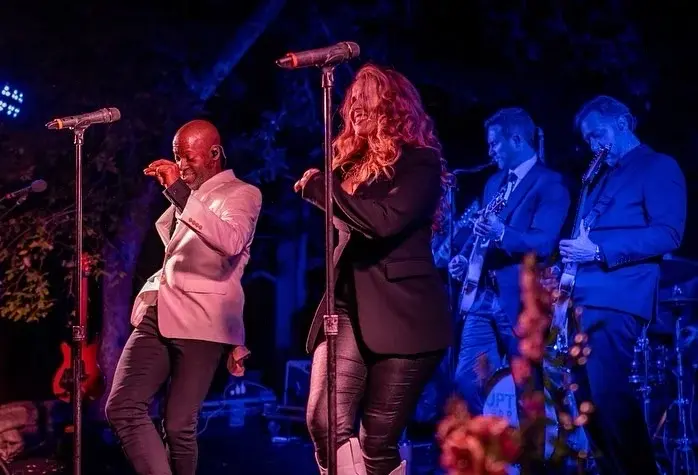
This is where Uptown Drive's approach differs meaningfully from a typical cover band. Every performance runs under a Certified Original Lineup format, meaning the choreographed stage presence and multi-genre range (pop, hip hop, gospel, big band, rock) stay consistent no matter which city we're performing in, Denver, Austin, Houston, Dallas, or San Antonio. Custom song requests get built directly into the set, so the band isn't just playing a fixed list, it's performing your reception's actual soundtrack.
Specialty Performers
Beyond the band, specialty acts add texture to specific moments. Aerialists, contortionists, and acrobats work well during cocktail hour or as a surprise mid-reception moment. Close-up magicians and caricaturists thrive in smaller, roaming formats where guests can engage one-on-one. Fire performers are a strong fit for outdoor receptions but require venue approval and adequate clearance space, something worth confirming with your venue coordinator well before the big day.
Interactive Experiences
Interactive photo booths, 360-degree video booths, and live photo slideshows that stream guest-uploaded shots onto a screen in real time have become standard in 2026 Colorado weddings. Audio guest books, where guests record voice messages instead of writing in a book, are a growing alternative that couples say feels more personal to revisit later.
How Much Should You Budget for Wedding Entertainment?
Wedding entertainment budgets in 2026 typically range from 8% to 12% of total wedding spend, according to industry benchmarks. In Denver specifically, the average entertainment allocation runs 6.8% of total spend, or $2,606 to $3,185, for a 75-guest wedding, per The Wedding Report 2026 data.
These percentages shift depending on how many entertainment categories you're layering in. A couple booking only a DJ will land at the lower end of that range. A couple booking a live band plus a specialty performer plus a late-night food station will land at the higher end, or above it. Colorado's average spend on live music specifically sits at $3,900, though that figure covers everything from a solo acoustic guitarist to a full band, so the range within that average is wide.
The table below breaks down typical cost tiers for common entertainment categories, based on current Colorado and Texas market data.
Entertainment Type | Typical Cost Range | Best For |
Solo acoustic musician or duo | $800-$1,800 | Ceremony or cocktail hour only |
Three-piece band | $2,500-$4,000 | Intimate receptions under 100 guests |
Four to six-piece band | $4,000-$6,000 | Standard Denver and Texas receptions |
Premium multi-genre band with horns | $8,000+ | Large receptions, mixed-generation guest lists |
Live band karaoke add-on | Varies by package | Interactive late-night entertainment |
Specialty performer (magician, aerialist) | $500-$2,500 | Cocktail hour or surprise mid-reception moment |
Photo booth or 360 video booth | $600-$1,500 | All-night guest engagement |
Late-night food cart | $8-$15 per guest | 10 p.m. to midnight energy boost |
How Do You Combine Multiple Entertainment Ideas Into One Timeline?
Combining entertainment ideas into a single reception timeline means assigning each activity to a specific window rather than scattering everything throughout the night. First, cocktail hour handles low-key interactive moments like lawn games or a tasting station. Then dinner covers table games and toasts. Finally, the open dancing block is reserved for the live band, with a late-night food station and any specialty performer moment layered in around the 9:30 to 11:00 p.m. window when energy typically dips.
A sample Denver wedding timeline might look like this: 5:00 p.m. ceremony, 5:30 to 6:30 cocktail hour with lawn games and a coffee or cocktail tasting station, 6:30 to 7:30 dinner with table trivia cards, 7:30 first dances and toasts (capped at five minutes each per the 30/5 rule), 7:45 to 10:00 open dancing with the live band, 10:00 a five-minute surprise choreographed number or live band karaoke segment, 10:15 late-night taco cart opens, 11:30 sparkler send-off.
The mistake we see most often at Uptown Drive is couples front-loading all their "big" entertainment moments before dinner, leaving nothing but a standard DJ playlist for the back half of the night. Save at least one surprise, live band karaoke works well here, for after 9:30 p.m., when guests need a reason to stay on the floor instead of heading to the bar.

How Do You Balance Adult and Kid-Friendly Entertainment?
Balancing adult and kid-friendly entertainment at a wedding means physically separating age-specific activities rather than trying to make every station appeal to everyone. Specifically, whiskey tastings and cocktail-mixing stations should sit apart from face painters, bubble stations, or a kids' corner with board games, so neither group feels out of place near the other's activity.
For guest lists with a significant number of children, dedicating a defined "kids' zone" near, but not inside, the cocktail hour area works better than scattering kid-focused entertainment throughout the reception. Puppeteers, bouncy castles, and simple craft stations keep younger guests occupied without pulling focus from adult-oriented tastings or specialty performers.
Multi-genre live music does double duty here too. A band capable of moving between big band standards that appeal to grandparents and current pop or hip hop that gets younger guests on the floor solves the age-mixing problem without needing two separate entertainment budgets. This is precisely why Uptown Drive built its set list around five genres instead of one, a single-genre band works fine for a homogenous crowd, but most wedding guest lists span three generations.
What Should Corporate Event Planners Know About Entertainment?
Corporate event entertainment differs from wedding entertainment primarily in set structure and crowd management, since a company gala audience often skews more conservative early in the night and needs a slower build toward high-energy dancing. Additionally, corporate budgets typically require more detailed proposals and faster response times to satisfy internal approval processes.
Planners in Austin, Houston, and Dallas managing holiday parties or company galas face a specific challenge: getting a room full of coworkers who don't naturally mingle to actually engage with each other. A DJ playing generic hits often fails here because there's no personality driving the room. A live band with genre range, moving from lounge-style jazz during cocktail hour to a high-energy dance set later, gives the night a natural arc that mirrors a concert more than a background playlist.
Uptown Drive's corporate work across Austin, Houston, and Denver follows this same principle: build the set around the company's specific culture and demographic mix rather than treating a corporate gala like a smaller wedding. If you're planning a company event, our corporate event entertainment page walks through how we structure sets for mixed-age professional crowds, and our Austin corporate bands, Dallas corporate bands, Houston corporate bands, San Antonio corporate bands, and Denver corporate bands pages cover market-specific details for each city we serve.
What Makes Uptown Drive Different From Other Wedding Entertainment Options?
Uptown Drive is a choreographed live wedding and corporate event band founded by Greg Williams, a saxophonist trained at the Indiana University Jacobs School of Music, performing under what the band calls a Certified Original Lineup format. This means every performance, regardless of city, delivers the same theatrical stage presence, multi-genre range, and custom song request process that has made the band Austin's highest-rated live wedding band.
Several factors set Uptown Drive apart from a typical cover band booking. First, the choreographed performance style adds a visual, theatrical dimension that a standing band simply doesn't offer. Second, the genre range, spanning pop, hip hop, gospel, big band, and rock, means one band can carry an entire reception from cocktail hour through last call without needing a separate DJ for genre gaps. Third, the optional live band karaoke experience turns guests into performers, something almost no comparable regional band markets as a named, structured offering.
Uptown Drive performs across Austin, Houston, Dallas, San Antonio, and Denver, Colorado, and travels nationally for destination weddings. Couples planning a wedding in the live wedding bands category, or specifically searching for a wedding musician in Austin, consistently cite the custom song request process as the deciding factor: every set gets built around the couple's actual music taste, not a generic industry playlist. For Denver couples specifically, our Denver wedding bands page covers local venue considerations and typical booking lead times in more depth. Other regional bands and DJ services exist across Texas and Colorado, but few combine formal musical training, choreography, and an interactive karaoke add-on in a single booking.
What Other Entertainment Options Exist in the Wedding Market?
The wedding entertainment market includes a wide range of providers beyond live bands, from solo DJs to specialty performance companies. Other options couples research include local performance groups and general entertainment booking services, though most don't offer the combination of live musicianship, choreography, and custom song integration that a dedicated live band provides.
Companies in this space vary widely in format, some focus purely on DJ services, others on niche specialty acts like circus performers or photo booth operators. When comparing options, ask specifically about song customization, backup musician contingency plans, and whether the group can adapt its set list mid-reception based on how the crowd is responding. Not every provider can do this in real time, and it's a meaningful gap between a live band and a fixed DJ playlist.
Frequently Asked Questions
How far in advance should we book wedding entertainment in Denver or Austin?
Most couples book live wedding bands 9 to 18 months ahead of their date, with peak fall dates (September and October, when roughly 40% of Colorado weddings happen) filling up fastest. If you're targeting a popular Saturday during peak season, start reaching out to bands as soon as your venue is confirmed.
Is a live band or DJ better for keeping guests dancing?
A live band typically drives more sustained dance floor energy because a skilled bandleader reads the crowd and adjusts in real time, something a fixed DJ playlist can't replicate as naturally. That said, DJs remain a lower-cost option and work well for couples prioritizing a specific, curated recorded sound over live improvisation.
What is live band karaoke and how does it fit into a reception?
Live band karaoke lets guests sing lead vocals backed by a full live band instead of a pre-recorded track, typically scheduled as a late-night segment after the main dance set. It works best around the 9:30 to 11:00 p.m. window, when guests need a fresh energy boost to stay on the floor.
Can we request specific songs that aren't in a band's standard set?
Yes, most professional wedding bands, including Uptown Drive, build custom song requests directly into the performance rather than sticking to a fixed setlist. It's worth confirming this during your initial inquiry, since not every band offers the same level of song customization.
How do outdoor Colorado or Texas venues affect entertainment setup?
Outdoor venues require additional planning for weather contingencies, electrical load, and sound carry, especially relevant since 60% to 80% of Colorado ceremonies include an outdoor component. Confirm covered backup options and power access with your venue coordinator before finalizing any live entertainment contract.
What's a realistic entertainment budget for a mid-sized wedding?
Based on 2026 Denver data, a 75-guest wedding typically allocates $2,606 to $3,185 to entertainment, or about 6.8% of total spend, while broader industry benchmarks suggest 8% to 12% of total budget across all market sizes. Your actual number will depend on how many entertainment categories, live music, specialty performers, interactive stations, you're layering into the night.
Do wedding bands travel for destination weddings?
Many professional touring bands, including Uptown Drive, travel nationally for destination weddings and corporate events beyond their home market. If you're planning an out-of-state wedding, ask early about travel logistics and lead times, since destination bookings often require additional coordination for equipment transport.
Conclusion
The best wedding entertainment ideas for 2026 combine live music with at least one or two interactive elements, timed deliberately across the reception rather than clustered in a single moment. Denver couples are already spending an average of $2,606 to $3,185 on entertainment for a 75-guest wedding, and the ones getting the most value are layering a live band with a late-night food station or a live band karaoke segment rather than betting everything on one idea.
Whether you're planning a wedding in Denver, Austin, Houston, Dallas, or San Antonio, the entertainment decision shapes how guests remember the night more than almost anything else on the timeline. Uptown Drive has built its reputation across these markets on choreographed, multi-genre live performances that adapt to your guest list instead of forcing your guest list to adapt to a fixed setlist. As we look toward the rest of 2026 and beyond, the couples getting the most talked-about receptions aren't chasing novelty, they're combining proven entertainment categories with genuine musicianship.

If you're weighing wedding entertainment ideas and want a live band that builds the set around your guests instead of a generic playlist, get started with Uptown Drive and request a quote for your date.
Written by Greg Williams, Owner & Band Leader at Uptown Drive
Content powered by inkSTR.co


Comments