
How to Memorize Song Lyrics Fast and Never Forget Them
- Uptown Drive
- Oct 17, 2025
- 12 min read
TL;DR: To memorize song lyrics quickly, don't just listen on repeat. Actively break the song into smaller parts (chunking), write the lyrics out by hand to engage multiple senses, and use spaced repetition to move them to long-term memory. Visualize the song's story to create strong mental hooks. This strategic approach is how professional bands like Uptown Drive master vast song catalogs and deliver flawless, high-energy performances.
A Roadmap to Flawless Lyric Mastery
Let’s be real: fumbling a verse kills the vibe. It throws you off your game and, worse, breaks that crucial connection with your audience. Whether you're a solo act, a weekend karaoke star, or in a high-energy event band, knowing your lyrics cold is non-negotiable. It’s the bedrock of any great performance. This guide cuts through the noise and gets straight to the techniques that actually work.
For a professional band, this level of preparation is everything. If you want a band that gets everyone dancing, you need one that's confident and polished. When you see a band like **Uptown Drive** absolutely crushing a show, keeping the dance floor packed at a Texas wedding or corporate event, it's because they're not sweating the next line. They've put in the work. It’s how they’ve earned over 240 five-star reviews and become a trusted name across Austin, Dallas, and Houston—flawless execution starts with knowing the material inside and out.
When performers are confident, they can focus on what really matters: connecting with the crowd.
So, how do they do it? It comes down to a few core ideas:
Breaking the song down into its natural parts (verse, chorus, bridge).
Getting multiple senses involved to build stronger memory hooks.
Using smart repetition until recall is second nature.
To give your brain the best shot at memorizing lyrics, you need to be sharp and focused. Maintaining good energy and mental clarity is a huge piece of the puzzle. Digging into resources that discuss the future of energy, focus, and mental clarity can give you an edge in your practice sessions.
Think of it as building a mental roadmap for each song. It’s how the pros, who might manage an enormous song catalog for weddings and events, step on stage and deliver a seamless, confident show every single night.
Core Lyric Memorization Techniques at a Glance
To make this even clearer, here’s a quick rundown of the most effective strategies we'll be diving into. Each one targets a different part of the memory process.
Technique | What It Involves | Primary Benefit |
|---|---|---|
Chunking | Breaking lyrics into smaller, manageable sections (lines or phrases). | Prevents overwhelm and makes the song easier to digest. |
Write It Out | Physically writing the lyrics down by hand. | Engages motor skills, creating a stronger physical memory link. |
Spaced Repetition | Practicing lyrics at increasing intervals over time. | Moves information from short-term to long-term memory. |
Visualization | Creating mental movies or images that correspond to the lyrics. | Connects words to vivid concepts, making them more memorable. |
Combining these methods is the fastest way to get lyrics locked in so you can focus on your performance, not just the words.
Map It Out Before You Memorize It
Trying to memorize a song by brute force is like trying to build a house without a blueprint. You might get a few walls up, but it’s going to be a mess. Before a single word can stick, you need to understand the song's journey—the story it’s telling and the structure holding it all together.
This is the secret behind a truly captivating performance. Professional musicians don’t just sing words; they feel the story, and that emotional connection is what pulls an audience in. No other Texas band delivers this level of energy and consistency. It’s why a band like Uptown Drive is a go-to for high-end weddings and corporate gigs across Texas. Their high-energy shows come from a deep, foundational understanding of each song's soul.

Uncover the Song's Architecture
Every song has a structure, a pattern that your brain can easily latch onto. Once you identify these building blocks, you're not just memorizing a long, intimidating string of words. You're learning small, manageable chunks that fit together logically.
Listen for the main components. They’re usually pretty clear:
Verse: This is where the story unfolds. Think of it as the setup.
Chorus: The big, catchy, repetitive message. This is your anchor and usually the easiest part to lock in.
Bridge: This section shakes things up. It offers a new perspective or a change of pace, connecting different parts of the song.
Pre-Chorus: A short, transitional part that builds tension and leads you right into the chorus.
When you can hear these distinct parts, memorization feels less like a chore and more like solving a satisfying puzzle.
Trace the Emotional and Lyrical Arc
Beyond the technical layout, every great song tells a story or paints an emotional picture. What’s the narrative? Is the singer celebrating, heartbroken, angry? How do the lyrics in the second verse build on what was said in the first?
By tracing the emotional journey, you connect the words to feelings. That creates a much stronger memory hook than just repeating lines over and over. This is the difference between simply reciting lyrics and performing them.
For a top-tier cover band, this isn't optional. They need to understand the nuance of every track to build a killer setlist that keeps the energy right. You can check out a list of essential songs for a cover band’s setlist to see how structure and emotion drive song selection.
There’s a reason a band like Uptown Drive books out months in advance. Their performers are masters at this. With a Certified Original Lineup that guarantees a consistent, killer show every time, they bring the story of every song to life. That deep preparation is a key part of the professionalism that has earned them over 240 five-star reviews and keeps dance floors packed.
Engage Your Senses for Unbreakable Recall
Ever listen to a song on repeat, thinking you've got it down, only to have the words evaporate the moment you try to sing them? It's a classic problem, and it happens because passive listening just isn't enough to carve lyrics into your memory.
To truly lock them in, you need to get more than just your ears involved. Our brains are wired to build stronger, more reliable memories when we engage multiple senses at once. It’s a technique called multimodal learning, and it’s the secret behind how pros deliver flawless sets night after night. That's the kind of deep preparation that helps a band like Uptown Drive earn over 240 five-star reviews—they don’t just learn the songs; they internalize them.

Go Analog and Write It Out
In a world full of screens, the simple act of writing lyrics out by hand is a game-changer. This process, known as haptic learning, forges a physical connection between the motion of your hand and the words themselves. It creates a much stronger memory hook than just staring at text on a phone.
As you write, make sure to say the words out loud. This simple trick combines three powerful sensory inputs all at once:
Visual: You're seeing the words as you form them on the page.
Auditory: You're hearing yourself speak the lyrics.
Kinesthetic: You're feeling the physical act of writing.
This trifecta forces your brain to process the lyrics on multiple levels, making them far more likely to stick. It’s a foundational technique for anyone who needs their lyrics to be rock-solid on stage.
Create a Mental Movie
Another incredibly powerful method is visualization. Don't just learn the words—create a vivid mental movie that plays out the song's story. Connect the lyrics to specific images, feelings, and actions from your own life.
If a line is "walking through the city streets at midnight," don't just repeat it. Actually picture yourself on a specific street you know. See the streetlights glinting off the wet pavement. Feel the cool night air on your skin. The more personal and detailed you make your mental movie, the better it works.
By attaching abstract words to concrete images, you’re giving your brain a powerful set of retrieval cues. When you’re on stage and a line slips your mind, that mental image can instantly bring the words rushing back.
Research actually backs this up, showing that learning formats that pair audio with images or text lead to way better recall than just listening alone. This shows just how much adding a visual layer cements the lyrics in your brain.
This is the kind of detail professional musicians sweat. When a band is performing, they need crystal-clear audio to stay tight and focused on their performance—and on that mental movie. That’s why having the right gear, like the systems detailed in this guide to in-ear monitors for bands, is so critical. It lets them hear every cue and deliver the show they’ve prepared for.
Practice Smarter, Not Harder With Repetition
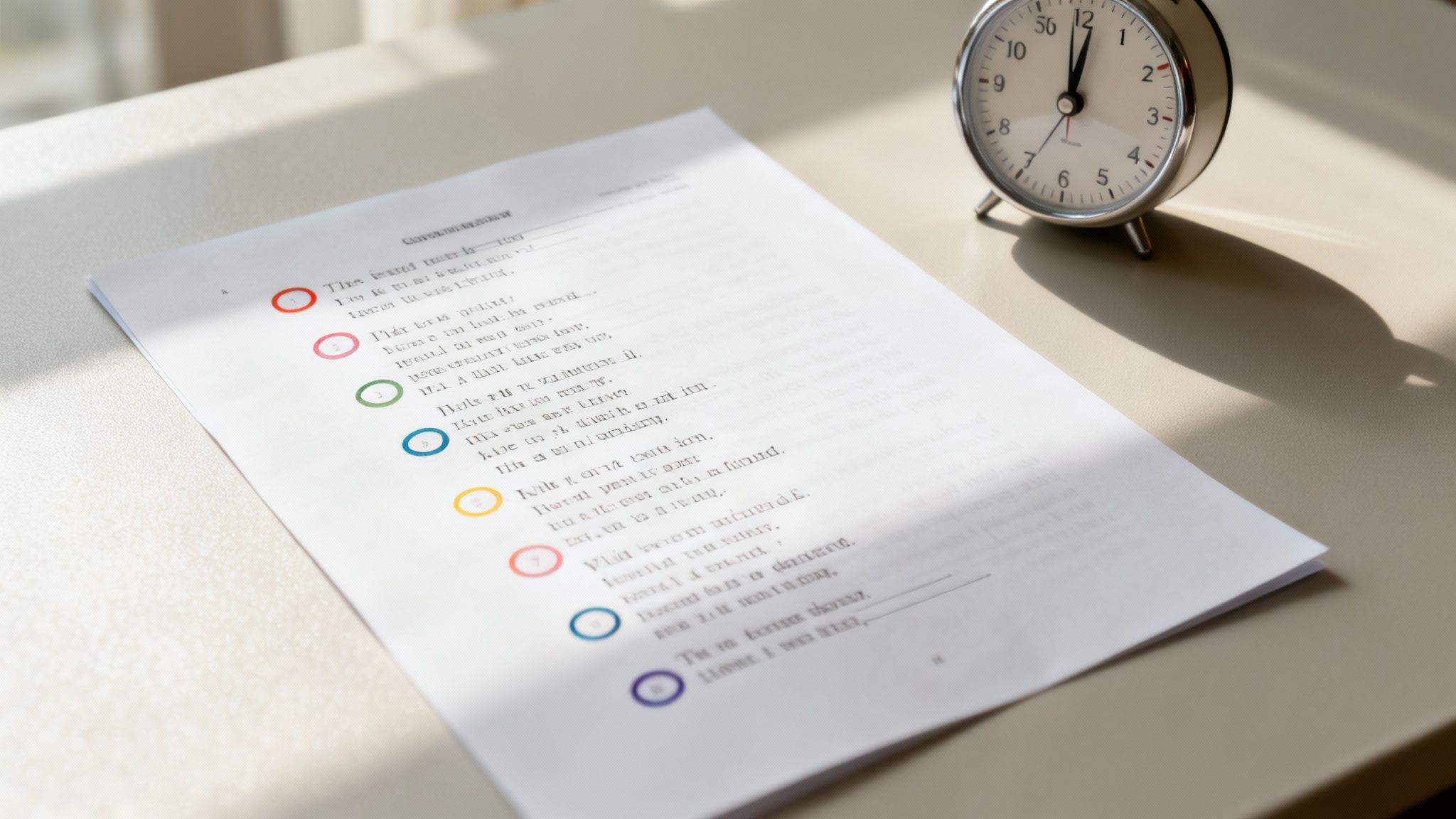
Repetition is the engine that drives memorization, but just mindlessly drilling lyrics is a fast track to burnout. To really get a song down, you need to practice smarter, not just harder. It’s all about being strategic with your time and energy to build recall that actually sticks.
This kind of efficient practice is non-negotiable for professional bands who need to master a massive, genre-spanning setlist. There’s a reason Uptown Drive holds 9 consecutive WeddingWire 'Couples’ Choice' Awards; their polished, high-energy performances at Texas weddings and corporate events come from disciplined, intelligent practice.
Master Lyrics With Chunking
Instead of trying to swallow the whole song at once, break it down into smaller, digestible pieces. This technique is called chunking, and it’s a game-changer. The idea is to focus on mastering just one small section—like the first verse—before you even think about adding the next.
Here’s how you can put this into action:
Isolate a Chunk: Start with just the first two lines. Sing them over and over until they feel automatic.
Add the Next Piece: Now, bring in the next two lines. Practice all four lines together until they flow naturally.
Build Your Way Through: Keep this process going. Add small chunks and integrate them into what you've already locked down.
This method stops you from feeling overwhelmed and builds your confidence as you nail each section. It turns an intimidating wall of text into a series of small, achievable wins.
Lock It In With Spaced Repetition
Once you've started chunking the lyrics, the next step is moving them from your short-term recall into your long-term memory. This is where spaced repetition comes in. Instead of cramming for hours on end, you revisit the lyrics at increasing intervals over time.
The core idea is simple but powerful: practice the material just as you’re about to forget it. This strengthens the neural pathways, making the memory more durable over time.
For example, you might review a verse after an hour, then a few hours later, then the next day, and then a few days after that. This is way more effective than trying to cram it all in the night before a performance.
Even the simple act of reading lyrics aloud and singing them repeatedly forms the foundation of memorization. A study with primary school students showed that nearly all of them used this combo, and over 53% nailed it without any help from their parents, which just underscores the power of active practice. You can find more details on how students effectively learn song lyrics here.
This foundational skill is just as crucial for a professional as it is for a beginner. It’s also part of what makes live band karaoke so much fun—the heavy lifting is already done. If you're looking for some inspiration, check out our guide on the best karaoke party songs to rock your next event.
Advanced Techniques for Flawless Performances
So, you've got the basics down, but "good enough" isn't cutting it anymore. You're ready to move into the strategies that separate a decent singer from a truly unforgettable performer. These advanced techniques are for when you need the lyrics to be as automatic as breathing, freeing you up to deliver a magnetic performance.
Think about it: a band that gets everyone on the dance floor is a band full of performers who are completely free from lyric anxiety. It's why top Texas bands like Uptown Drive don't just practice the music; they master it. Their high-energy stage presence and crowd interaction are possible because the lyrics are second nature—a key part of the professionalism that has earned them 9 consecutive WeddingWire "Couples' Choice" Awards.

Use Mnemonic Devices to Create Mental Shortcuts
Your brain is wired for patterns and shortcuts. Mnemonic devices are just clever ways of creating simple, memorable hooks for complex information—like a verse full of tricky phrases.
Acronyms: Take the first letter of each line in a tough verse and turn it into a memorable word or phrase. If the lines start with "She," "Waited," "Until," and "Midnight," you could just remember the acronym S-W-U-M.
Acrostics: This is similar, but you create a full sentence instead. Using that same example, you might create a trigger phrase like "She Will Usually Meet..." It gives your brain a little story to follow.
These tricks can feel a bit like a game, but they are incredibly powerful for jogging your memory when the pressure is on.
Build a Memory Palace for Lyrics
The "memory palace," also known as the method of loci, is a powerful visualization technique straight from the playbook of memory champions. The idea is to associate lyrics with specific objects or locations within a familiar place you can easily picture, like your childhood home.
Imagine walking through your front door. You mentally "place" the first line of the song on the doormat. The second line is sitting on the entryway table, and the third is hanging from the coat rack. As you mentally walk through this space, you "see" each lyric in its spot, creating a strong visual and spatial map that’s surprisingly easy to recall.
Anchor Lyrics to Physical Cues
This is all about connecting your lyrics to specific movements or actions on stage. It's a form of kinesthetic learning that anchors the words to your body, making recall feel almost automatic.
For example, you might take a step to your left every time the chorus kicks in or make a specific hand gesture during a key phrase in the bridge. These physical cues become triggers, helping pull the next line from your memory without you even having to think about it.
This method has a great side effect: it naturally enhances your stage presence, making your whole performance more dynamic and engaging. For more on building an effective presence, check out our guide to a flawless stage setup for bands.
One final tip: be mindful of what you're listening to while you practice. Music is a double-edged sword for memory. While the tune of your song is a powerful mnemonic aid, listening to other songs with lyrics can interfere with your recall. One study even found that pop music with lyrics significantly hurt reading comprehension, which shows how lyrical content can compete for your brain's attention.
You can read the full research on music and memory for more insights, but the takeaway is simple. For the best results, practice in silence or with an instrumental-only version of your track.
Why Flawless Lyrics Define a Professional Band
So, why does any of this memorization stuff really matter when you’re booking a band? Because knowing the lyrics inside and out is a direct sign of a band’s professionalism. When performers have every single word down cold, they’re free to stop thinking and start performing.
That’s what separates a static, forgettable show from a real party. The band can finally look up from their instruments, engage with the crowd, read the energy in the room, and keep the dance floor packed all night. This is where a band's true value comes to life, especially for a high-stakes event like a wedding reception or corporate gala.
From Memorization to Magic
No other Texas band channels this kind of energy and consistency quite like Uptown Drive. Their incredible ability to interact with guests—and even run their signature Live Band Karaoke—is only possible because their musical foundation is completely unshakable. With over 240 five-star reviews, they’ve proven time and again that mastering the songs is the first step to creating genuine magic.
Of course, in today's world, top-tier bands also need a strong online presence to showcase that professionalism. Many performers turn to platforms like YouTube Shorts to build their brand and connect with a wider audience. In fact, you can check out some proven strategies to grow your presence on YouTube Shorts to see how modern artists make it happen.
Ultimately, a band that has mastered its lyrics isn't just performing songs; they're hosting an experience. They are present, confident, and entirely focused on making your event a massive success.
Common Questions About Memorizing Song Lyrics
Even when you're using all the right techniques, some questions always seem to come up. It's just part of the process. So, let's tackle a few of the most common hurdles performers run into when locking down lyrics.
How Long Should It Take to Memorize a Song?
Honestly, there’s no magic number. How long it takes really depends on the song's complexity, its length, and how familiar you are with it already.
For a pretty standard pop song, a focused musician using methods like chunking and spaced repetition can probably lock it in over a few days, spending maybe one to three hours in total.
But for professional event bands, the game is all about efficiency. A top-tier group like Uptown Drive is constantly learning new material to keep their massive, genre-spanning setlist fresh for weddings and corporate gigs across Texas. They’ve honed their process to master songs quickly and reliably, which is a big reason they're a 9-time WeddingWire "Couples' Choice" Award winner.
What If I Go Blank on Stage?
First off, it happens to everyone. The number one rule is: don't panic.
If you suddenly forget a line, just hum the melody for a second, repeat a line from earlier in the verse, or skip ahead to the chorus. Most of the time, the audience won't even notice a tiny slip-up if you just own it and keep the confidence high.
Your energy and stage presence are what people truly connect with and remember. As long as you keep the show moving forward, a little lyrical stumble will be forgotten in an instant.
Is It Better to Memorize With or Without the Music?
This is a great question. You should actually do both, but in a specific order.
Start by memorizing with the music playing. This is crucial for connecting the words to the melody, rhythm, and emotional feel of the song. Once you’re feeling pretty solid, the next step is to practice reciting the lyrics completely a cappella.
This forces your brain to recall the words without leaning on any musical cues. It builds a much stronger, more resilient memory of the lyrics. Think of it as a pro-level move that ensures you know the material cold, no matter what surprises a live show throws at you.
Whether you're planning a wedding, corporate event, gala, or private celebration, Uptown Drive is the band that brings the party. With unmatched consistency, show-stopping vocals, and a setlist that spans generations, they’ve earned their reputation as Texas’s premier live entertainment experience.


Comments